Wig Size Selection Guide: How to Find the Wig That Fits You Best
May 27, 2026 · Marcus Vore
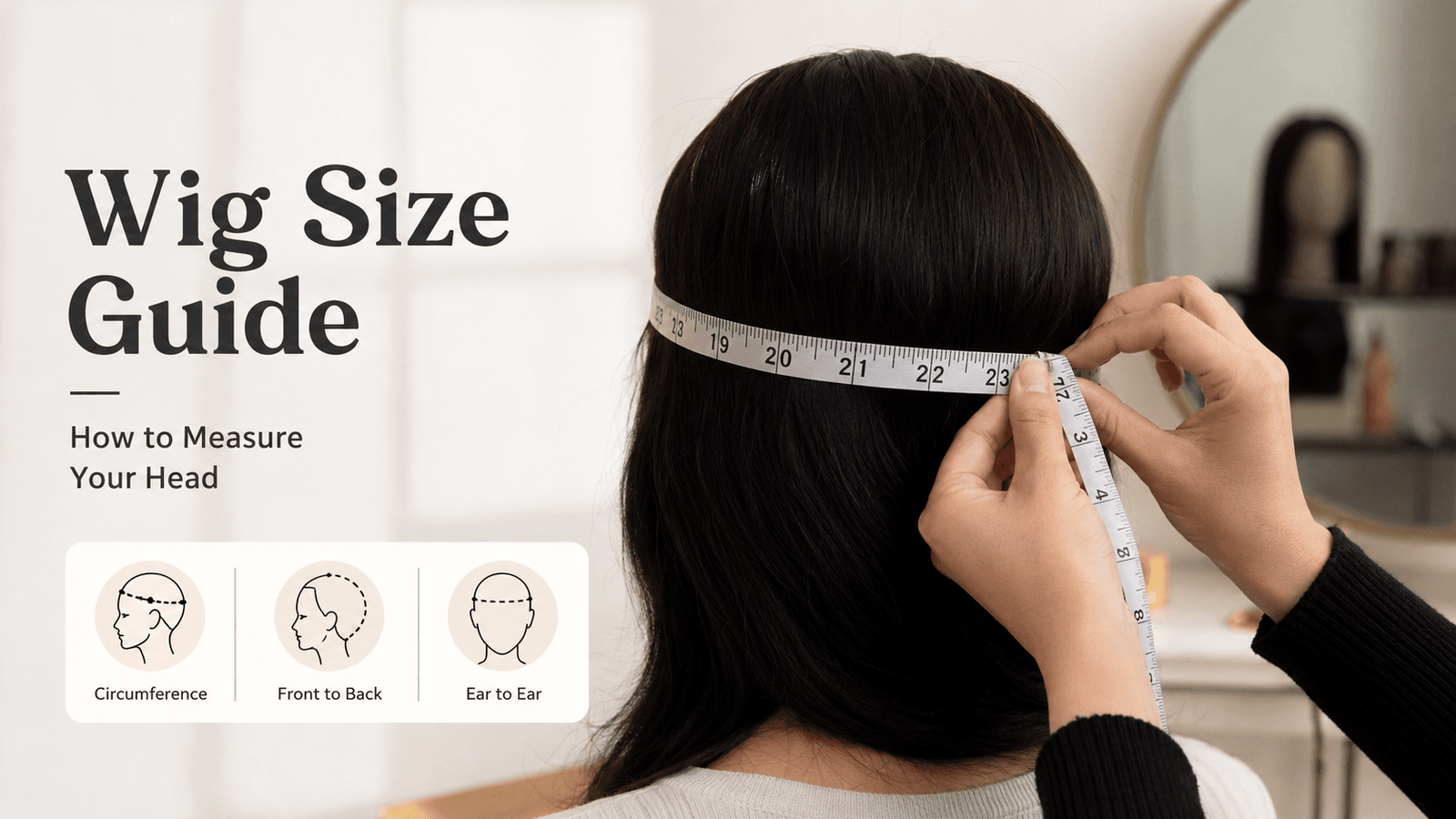
To find a wig that fits, measure your head circumference, front-to-back depth, and ear-to-ear width, then match those three numbers to a standard size chart. The average adult head measures 22 to 22.5 inches in circumference, which corresponds to a medium wig cap with adjustable straps that provide roughly 1 inch of flexibility in either direction.
When Jessica received her first wholesale wig shipment of 50 units, she expected to start selling immediately. Instead, 12 wigs came back in the first month, not because of hair quality or lace type, but because they didn't fit. Her customers ranged from petite to plus-size, yet she'd ordered everything in "standard medium." That was a $1,200 lesson in a truth most first-time buyers miss: wig sizing isn't one-size-fits-most.
If you think wig sizing is as simple as small, medium, and large, you're not alone. Most buyers learn the hard way that head dimensions vary significantly from person to person, and no amount of premium lace or virgin hair can save a wig that slides around or causes temple pain within an hour of wear.
By the end of this guide, you'll know exactly how to measure for a wig, what each size means in actual inches, which cap construction types affect fit the most, and how to stock sizes that match your customer base, whether you're buying for yourself or ordering wholesale inventory for resale.
Key Takeaways - 90 to 95% of adults fit a medium (22.5") wig cap, but the 5 to 10% who don't will return every wig that doesn't fit, and returns from sizing issues eat wholesale margins fast - The three essential measurements are head circumference, front-to-back depth, and ear-to-ear width; skip any one and you're guessing - Most wigs include adjustable straps with 1 to 2 inches of range, but they can't fix a full-size mismatch - Cap construction determines fit forgiveness, full lace conforms the most, machine-made the least - When ordering wholesale, stock 70% medium, 20% large, 10% small for general markets, then adjust based on what your customers tell you
Why wig cap size matters more than you think
A wig that's too tight causes headaches and tension around the temples within an hour of wear. A wig that's too loose shifts when the wearer turns their head, exposes the hairline at the edges, and in the worst cases slides backward off the crown. Neither problem has anything to do with hair quality, lace type, or density. Both are 100% fit-related, and both lead to the same result: a return.
For wholesale buyers, the stakes compound quickly. Returns caused by sizing issues look like this in practice:
Sarah runs a salon supply business in London. She ordered 30 lace front wigs in medium for her diverse customer base, "because everyone's a medium, right?"
Within two weeks, three customers returned wigs that were too tight at the temples. Two more complained the caps gaped at the nape. That meant $350 in refunds and five unhappy customers who may never buy from her again.
"Nobody talks about sizing when you're learning to buy wigs wholesale," Sarah told us. "The conversation is all hair grade and lace type. But if the wig doesn't fit, nothing else matters."
Here's what sizing problems cost at scale:
| Problem | Result | Cost per 50-unit order |
|---|---|---|
| Wig too tight | Headaches, returns, negative reviews | 3 to 5 returns = $150 to $350 lost |
| Wig too loose | Slides around, unnatural hairline, return | 2 to 4 returns = $100 to $280 lost |
| Wrong size mix for market | Slow-moving inventory, cash tied up | Hours spent discounting or repackaging |
Getting size right protects your margin and your reputation, and it starts with understanding exactly what the numbers mean.
Need help figuring out your size mix? Tell us about your target customers on WhatsApp and we'll recommend a size breakdown based on what we see working for similar buyers. No commitment needed.
Standard wig size chart explained
Wig manufacturers use circumference as the primary size indicator, but two additional measurements matter almost as much: front-to-back depth and ear-to-ear width. A wig that matches your circumference but is too shallow front-to-back will ride up at the nape. One that matches ear-to-ear but is too tight in circumference will cause temple pain within the first hour.
Here's the standard size chart used by most factories in China:
| Size | Circumference | Front-to-back | Ear-to-ear |
|---|---|---|---|
| Petite | 20.5 to 21" (52 to 53 cm) | 12.5 to 13" (32 to 33 cm) | 12.5 to 13" (32 to 33 cm) |
| Small | 21 to 21.5" (53 to 54 cm) | 13 to 13.5" (33 to 34 cm) | 13 to 13.5" (33 to 34 cm) |
| Medium / Average | 22 to 22.5" (55 to 57 cm) | 14 to 14.5" (35 to 37 cm) | 13.5 to 14" (34 to 35 cm) |
| Large | 23 to 23.5" (58 to 60 cm) | 15 to 15.5" (38 to 39 cm) | 14 to 14.5" (35 to 37 cm) |
| Extra Large | 24 to 24.5" (61 to 62 cm) | 15.5 to 16" (39 to 41 cm) | 14.5 to 15" (37 to 38 cm) |
The "average" designation for medium isn't marketing language, roughly 90 to 95% of adult women fall into this range. But the 5 to 10% who don't have few options in standard retail, which is exactly why buyers who serve diverse markets should carry at least small and large alongside medium.
What the adjustable straps actually do
Most wigs include adjustable straps at the nape of the neck with 1 to 1.5 inches of adjustment range. These straps can: - Tighten a medium cap down by about 1 inch (effectively to a small-medium) - Loosen a medium cap out by about 1 inch (effectively to a medium-large) - NOT bridge a full size gap, a medium with straps fully loosened will still pinch someone who genuinely needs a large
The straps are designed for the "in-between" cases, not the true outliers. This is worth understanding before you assume "the straps will handle it."
Cap construction and how it affects fit
Not all wig caps fit the same, even within the same stated size. Construction method changes how a cap sits on the head and how much flexibility it provides.
Full lace caps have the most flexible fit because the entire cap is hand-tied lace that conforms to the wearer's head shape. They're the most forgiving option for measurements that fall between sizes. The trade-off: full lace is the most expensive construction and the least durable, the thin lace tears more easily at stress points, especially along the hairline and part line.
Lace front with machine-made back is the most common wholesale construction. The lace front molds to the hairline, while the structured machine-made back holds the cap shape. These fit slightly firmer than full lace, if you're between sizes, you'll feel the tightness more in the structured back section. They're more durable and cost less than full lace.
360 lace caps provide a lace perimeter around the full hairline with a machine-made crown. Fit flexibility sits between full lace and standard lace front, more forgiving in the back (because the nape and sides are lace) but still structured through the top.
Machine-made / basic caps have minimal flexibility. They're the most durable and the cheapest per unit, but the least forgiving on fit. If you stock basic caps, size accuracy matters the most, there are no lace panels to stretch or conform.
When Maria, a salon owner in Toronto, switched from basic machine-made caps to lace front wigs for her retail shelf, she tracked a drop in fit-related complaints from roughly 15% to under 5%. "I thought my clients were just bad at measuring their heads," she said. "Turns out the basic caps had zero give. The lace fronts forgave the half-size differences."
The takeaway for wholesale buyers: factor fit forgiveness into your construction decision alongside durability and unit cost. A $5-cheaper cap that generates 3 extra returns per 50 units isn't cheaper at all.
How to measure your head for a wig
You need a flexible tailor's measuring tape, the soft fabric kind, not the metal hardware kind. If you don't have one, use a piece of string or ribbon and measure the marked length against a ruler afterward. Do not measure over thick or textured hair, flatten or tie back natural hair first, or you'll add up to 1 inch to every measurement.
Step 1: Circumference
Wrap the tape around your head starting at the front hairline, passing just above the ears, going around the fullest part of the back of the head, and meeting at the nape of the neck. Keep the tape flat against the scalp, don't pull it tight enough to indent, but don't leave slack either.
Take this measurement three times and average the results. Even a small shift in tape position can change the reading by a quarter to half an inch, which is the difference between fitting comfortably and pinching.
Step 2: Front-to-back
Place the tape at the center of your front hairline and run it straight back over the crown to the nape of your neck. This determines how deep the wig cap needs to be. If a cap is too shallow, the wig rides up at the back throughout the day. Too deep and you'll have excess material bunching at the nape.
Step 3: Ear-to-ear
Place the tape at the top of one ear, run it over the crown of your head, and down to the top of the other ear. This measures the widest point the cap needs to accommodate. A cap that's too narrow here will gap at the temples on either side, one of the most common and most visible fit problems.
Step 4: Temple-to-temple (for lace front wearers)
If you wear lace front wigs, measure from temple to temple across your front hairline. This tells you whether standard lace dimensions (13x4 or 13x6) will fully cover your hairline. Buyers with wider temple-to-temple measurements may need larger lace panels for adequate coverage.
Step 5: Nape width (for full cap wigs)
Measure across the back of your neck at the natural nape line. This is the bottom edge width the wig needs. If your nape measurement is wider than the standard for your circumference size, full cap wigs will feel tight at the back regardless of how the rest of the cap fits.
Measuring for your customers
If you're a salon owner or retailer measuring clients in person: - Have the client sit at eye level so you can hold the tape horizontal, measuring from above distorts the reading - Take all three primary measurements even if the client says "I'm always a medium", memory is unreliable and weight changes shift measurements - Write down numbers in both inches and centimeters so you can communicate with suppliers in either unit - Flatten or tie back the client's hair first, measuring over natural hair adds bulk that inflates every number
What if your measurements don't match standard sizes?
Most people's heads aren't perfectly proportional to a size chart. You might have a medium circumference but a large front-to-back depth, or a large ear-to-ear width with a medium circumference. Here's how to handle the three most common mismatches:
Circumference = medium, front-to-back = large: Choose the large cap and use the adjustable straps to tighten the circumference. A medium cap will ride up at the back because it's too shallow, tightening the straps won't fix a depth problem.
Circumference = large, front-to-back = medium: Try a large cap with the straps tightened. In some cases a medium with straps fully loosened will also work. Order samples in both sizes and wear test each for at least 4 hours before committing to bulk.
Ear-to-ear wider than standard for your circumference: This is the hardest mismatch. The wig will gap visibly at the temples. Look for wigs with wider lace dimensions (13x6 instead of 13x4) or, if you're ordering wholesale, request custom cap sizing from your supplier.
Most Chinese factories will adjust cap dimensions on orders of 30 units or more.
The general rule: when your measurements conflict across the chart, prioritize the largest measurement and use the straps to tighten where needed. It's easier to make a wig slightly smaller than to stretch one larger.
For wholesale buyers serving diverse markets, this is why stocking at least two sizes, medium and large, is non-negotiable. The customer who needs a small can sometimes make a medium work with the straps tightened fully. The customer who needs a large can almost never make a medium work with the straps loosened.
Common wig fit problems and how to fix them
Gap at the temples
The lace lifts away from the skin on either side of the forehead, creating a visible shadow line that makes the wig look obviously artificial.
Cause: Ear-to-ear measurement is wider than the wig cap width, or the overall cap circumference is too large and the wig isn't sitting properly against the head.
Fix: Tighten the adjustable straps first. If the gap persists, the cap is genuinely too large for the wearer. For lace front wigs, wig tape or adhesive applied at the temples can close the gap. A wider lace panel (13x6 vs 13x4) provides more coverage and is more forgiving of this issue.
Rides up at the nape
The back of the wig creeps upward through the day, eventually exposing the natural hairline at the neck.
Cause: Front-to-back depth is too shallow, the cap doesn't extend far enough down the back of the head.
Fix: Loosen the adjustable straps so the cap can sit lower on the head. If the wig still rides up after full loosening, the cap is at least one size too small front-to-back.
Too tight at the temples
Headache or pressure point pain within 30 to 60 minutes of wear, concentrated at the sides of the head.
Cause: Circumference is too small, or ear-to-ear measurement is narrower than the wearer's actual width.
Fix: Loosen the adjustable straps to their maximum setting. If tightness persists, the cap is one full size too small, no amount of stretching will resolve the issue, and continued wear risks damaging the cap at the seam points.
Slides back on the head
The entire wig shifts backward throughout the day, exposing more forehead and making the hairline look set too far back.
Cause: Circumference too large for the wearer, or the wig isn't adequately secured.
Fix: Tighten the adjustable straps first. If sliding continues, add a wig grip band (a velvet-textured headband worn under the wig) or apply wig tape at the front hairline. If these don't stabilize the wig, the cap is genuinely too large and needs to be exchanged.
Excess material at the crown
Fabric bunches or folds at the top of the head, visible under the hair when the wig is worn.
Cause: Cap circumference or front-to-back depth is too generous for the wearer's head shape.
Fix: Tighten straps and re-position the wig further forward on the head. If bunching persists but the hair coverage hides it completely, this is sometimes acceptable, the fit issue is cosmetic only. If the bunching is visible or causes the wig to shift, the wearer needs a smaller size.
How to order the right size mix from your supplier
For wholesale buyers, the question isn't just "what size do I need?" but "what sizes should I stock?"
Here's the size distribution we see working across our buyer base:
| Customer market | Small | Medium | Large | Notes |
|---|---|---|---|---|
| General US/UK market | 10% | 75% | 15% | Standard distribution for most retailers |
| African and Caribbean markets | 5% | 70% | 25% | Higher large-size demand in these markets |
| Asian markets | 20% | 70% | 10% | Higher petite and small-size demand |
| Online general (global audience) | 10% | 70% | 20% | Offering size selection at checkout lifts conversion |
David launched his e-commerce wig store with 40 units, 35 mediums and 5 larges. "I figured I'd add smalls if anyone asked," he said.
In his first month, three customers specifically asked for small caps. He had nothing to offer them. Worse, his large-cap customers became repeat buyers within weeks, and he nearly sold out of large inventory while sitting on 15 unsold mediums. He'd ordered the size mix backward for his actual demand.
What David should have done: order 25 mediums, 10 larges, and 5 smalls for the initial batch. The smalls would sell slower, but they'd generate data on what his market actually needs, and 5 units is a cheap price for real market intelligence.
Verify sizes before committing to bulk
When placing your first order with any supplier, order samples in all available sizes before committing to bulk. Then verify three things:
-
The size chart from your supplier matches the actual measurements of their caps. Ask the supplier to measure a sample cap on video, circumference, front-to-back, ear-to-ear, with the measuring tape clearly visible. A supplier who won't do this on video is telling you something.
-
The adjustable straps provide at least 1 inch of range in both directions. Test this on the sample yourself.
-
The cap construction type delivers the fit flexibility you expect. A "medium" in full lace fits differently than a "medium" in a machine-made cap from the same factory. Don't assume consistency across constructions.
For more detail on vetting suppliers before placing orders, read our guide on how to find reliable suppliers in China. If you're new to importing, our shipping from China guide covers freight options, timelines, and what to expect from sample delivery through bulk orders.
The same verification principles apply whether you're evaluating hair quality or cap sizing accuracy. Our 4-step quality verification process, factory audit, sample approval, production QC, and pre-shipment inspection, applies to every product category we source.
Frequently asked questions
How do I know my wig size without a measuring tape?
Take a piece of string or ribbon and wrap it around your head following the circumference measurement path, front hairline, above the ears, around the back, meeting at the nape. Mark where the string overlaps, then lay it flat against a ruler. The length is your circumference. Repeat for front-to-back and ear-to-ear measurements.
What is the most common wig size?
Medium (22 to 22.5 inch circumference) fits roughly 90 to 95% of adult women. It's the default size most manufacturers produce and most retailers stock. But "most common" is not "universal", the 5 to 10% who need small or large sizes account for a disproportionate share of returns and negative reviews.
Can I make a wig smaller?
Yes, within limits. Adjustable straps can tighten a wig by about 1 inch. For additional tightening, you can sew extra elastic into the cap, add velcro adjustment points, or wear a wig grip band underneath. Combined, these methods can reduce effective size by roughly 1.5 to 2 inches total, they can't turn a large cap into a small one.
Can I stretch a wig that's too tight?
Slightly, yes. Significantly, no. A wig that's tight by roughly half an inch will often relax with wear as the cap material warms to body temperature. You can also dampen the cap slightly and place it over a mannequin head one size larger to encourage gentle stretching overnight. But a wig that's a full size too small won't stretch enough, the continued tension will damage the cap at the seams and the wearer will be uncomfortable regardless.
Does wig size change with hair length?
The cap size doesn't change, but the perceived fit can shift noticeably. Longer, denser hair adds weight to the wig, a 26-inch 180% density wig weighs significantly more than a 14-inch 150% density wig in the same cap. That additional weight pulls backward, making a slightly loose cap feel looser and more prone to sliding. For wigs 22 inches and longer, a snugger fit becomes more important because hair weight works against cap security.
How do I measure a child's head for a wig?
The measurement method is identical, but children's heads typically measure 19 to 21 inches in circumference. Most standard adult wig caps will be too large. Look for suppliers that explicitly offer petite (20.5 to 21") or children's cap sizes. The average 8 to 12-year-old measures roughly 20.5 to 21.5 inches.
What if my head measurements change over time?
Hair loss, weight fluctuations, and hormonal changes can shift head measurements by a quarter to half an inch. If it's been more than a year since your last measurement, or if you've experienced significant weight change, re-measure before placing an order. Regular wig wearers typically confirm their measurements annually as a matter of practice.
Get the fit right before you commit to bulk
Wig size affects your return rate as much as hair quality does. A buyer who knows their measurements and receives a wig that matches them is unlikely to return it. A buyer who receives a beautiful wig that doesn't fit is almost certain to return it, and they'll blame the quality, not the sizing, when they describe their experience to others.
Here's what to do next:
- Measure your head (or your customer's head) using the three-point method described above
- Match your measurements to the standard size chart, prioritizing the largest measurement when numbers conflict
- Order a sample in your indicated size and wear test it for at least a full day before committing to bulk
- If ordering wholesale, stock at least medium and large with small as a test option
- Ask your supplier for a measurement video to verify their caps match the size chart they provided
Whether you're buying your first wig or building inventory for your business, size comes before everything else. Lace type, hair grade, and density don't matter if the wig doesn't stay on your customer's head.
Need help figuring out the right sizes for your market? Reach out and tell us about your target customers, we'll help you get the size breakdown right before you place a single order.
- WhatsApp: +86 17347350405 (fastest response)
- Email: hello@voretrade.com
No commitment, no hard sell. Just a conversation about what works for your customers.