Wig Hair Density Guide: What 100, 110, and 120 Density Mean and How to Choose the Right One
August 9, 2026 · Marcus Vore
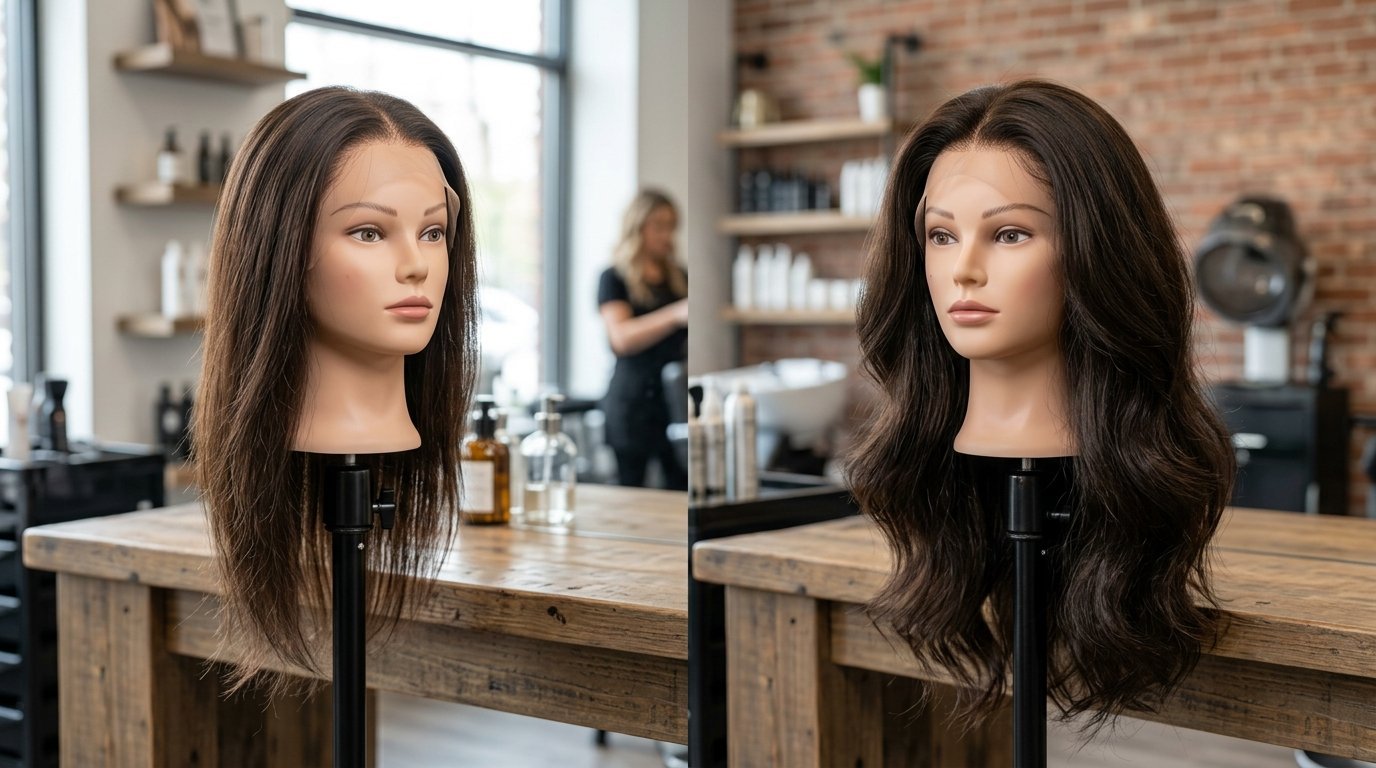
When you shop for a wig, density is listed right there in the product specs -- 100%, 110%, 120%, 150%, 180%. Most buyers glance at it, assume higher means better, and pick a number without fully understanding what they are ordering. Then the wig arrives and it either looks disappointingly flat or absurdly thick. The density number affects everything: how natural the wig looks, how the lace blends at the hairline, how comfortable the cap feels on your head, and ultimately how convincing the finished style is.
This guide explains what hair density in wigs actually means, what you will see and feel at 100, 110, and 120 density levels, and how density and lace interact to affect the realism of your hairline.
What Does Wig Hair Density Actually Mean?
Wig density is expressed as a percentage that compares the thickness of the wig's hair to the average thickness of a naturally full head of human hair. A natural, unaltered human scalp is considered the 100% baseline. So:
- 100% density = hair thickness equivalent to an average natural head of hair
- 120% density = slightly fuller than the natural average
- 150% density = notably thicker and more voluminous than average
- 180% density = very heavy, theatrical volume significantly beyond what grows naturally on most people
The percentage does not refer to the number of hairs in the wig. It is a relative measure of thickness at the weft level -- how densely packed the hair tracks are as they are sewn into the cap. Different manufacturers calibrate this slightly differently, which is why a "120% density" wig from one brand may feel visibly lighter or heavier than a "120% density" wig from another. That said, the general scale holds across most of the market.
100 Density Wigs: The Natural Baseline
A 100 density wig is the starting point -- a wig constructed to match what typical natural hair looks like. When you put it on, it should feel like a normal head of hair rather than a theatrical hairpiece. The weight is light to moderate, and the hair does not pile up dramatically at the ends.
Who is a 100 density wig best for? It suits buyers who:
- Have naturally fine or thin hair and want the wig to look proportionate to their frame
- Are going for a subtle, understated aesthetic rather than a glamorous statement look
- Want maximum scalp breathability and comfort during long wear days
- Are newer to wearing wigs and find that lighter caps are easier to manage and style
The risk at 100 density: if the hair quality is mediocre, a lower-density wig can look sparse rather than naturally light. The hair quality matters more at lower densities because there is less hair overall to compensate for any inconsistency in the weft construction.
110 Density Wigs: The Practical Middle Ground
A 110 density wig is the quiet workhorse of the density range. It adds a modest but noticeable improvement in fullness over 100% without crossing into the heavy, obviously-augmented territory that higher densities can produce. The hair has good body and movement, the ends are full enough to hold a style, and the overall effect is of someone with genuinely healthy, thick natural hair rather than an obviously boosted hairpiece.
For everyday lace front wig buyers who want a realistic look without spending hours trying to de-puff an overly thick cap, 110 density hits a practical sweet spot. It is forgiving across styling choices -- it looks convincing worn straight, in waves, or in a ponytail -- and it does not require constant thinning-out techniques to avoid a wig-like silhouette.
120 Density Wigs: Full Without Being Excessive
A 120 density wig -- or 120 density human hair wig -- is the most commonly recommended density for buyers who want a genuinely full, lush look without going into theatrical territory. It reads as "great hair day" rather than "obviously enhanced hair." The additional volume over 110% shows most at the mid-lengths and ends, giving curls and waves more definition and giving straight styles a glossy, thick-curtain effect that photographs exceptionally well.
120 density is particularly effective for:
- Body wave and deep wave textures, where the additional density helps curls form full, defined spirals that do not look stringy
- Straight styles worn for formal occasions or photography where a very polished, high-volume effect is the goal
- Buyers with naturally thick hair who feel that lower densities look thin relative to their own build
- Wigs worn for social situations where you want the hair to make a statement
The upper limit of what reads as natural on most people is generally somewhere around 130-150%. A 120 density wig stays comfortably below that ceiling, which is why it has become a go-to recommendation for buyers who want volume without the wig-obvious look.
Density and Lace: How They Interact at the Hairline
This is the relationship most buyers overlook: the density you choose does not just affect how the body of the wig looks. It directly impacts how the lace front looks at the hairline.
At the hairline of any lace front wig, the hair transitions from the natural density of the wig body down to the sparse, pre-plucked density of the baby hairs along the hairline edge. This transition -- from full to sparse -- is what creates the illusion of a natural scalp. The higher the base density of the wig, the more abrupt and noticeable this transition becomes.
Consider what happens with a 180% density wig: the body of the wig is extremely thick, and then the hairline suddenly drops to sparse baby hairs. The visual contrast is jarring and instantly reads as artificial to most observers.
With a 120 density wig, the body density is full but not extreme, so the pre-plucked hairline transition is gradual and believable. The viewer's eye moves smoothly from the hairline into the hair body without a dramatic density shift that breaks the illusion.
Practically, this means:
- A 100-120 density wig with a high-quality HD lace frontal will almost always look more natural at the hairline than a 150-180 density wig with the same lace
- If you are prioritizing a convincing, undetectable hairline -- especially for a lace front that you wear without glue in situations where people are close to you -- choosing a moderate density is as important as choosing good lace quality
- Higher densities are best suited for styles where the hairline is less scrutinized (worn in a bun or ponytail) or where the theatrical fullness is the deliberate aesthetic goal
Choosing the Right Density for Your Situation
| Density | Best For | Avoid If |
|---|---|---|
| 100% | Fine hair, subtle everyday look, maximum breathability | You want glamorous volume or a statement style |
| 110% | Natural thickness, flexible everyday styling, realistic daily wear | You specifically need dramatic volume for events |
| 120% | Full lush look, waves and curls, formal occasions, thick natural hair | You want an understated, very natural look at very close quarters |
| 150%+ | Fashion statements, performance, specific styled looks | Natural everyday realism is the priority |
Frequently Asked Questions
Is 120 density too much for everyday wear?
For most people, 120 density is not too much for everyday wear -- it is actually the most popular density for exactly that reason. It produces a naturally full look that photographs well, holds styles easily, and does not read as obviously enhanced in normal social situations. The concern about density being "too much" for everyday wear typically applies at 150% and above, where the volume becomes heavy enough to attract notice and the cap weight can cause discomfort after long wearing sessions. At 120%, the hair is full but the cap is not particularly heavy, and the daily styling experience is not meaningfully more demanding than a lower-density wig. The main exception: if you have a very petite frame or very fine bone structure, extremely high-volume hair can look disproportionate relative to your overall size. In that case, 110% might be the better everyday choice for you specifically, while 120% works beautifully for occasions when you want a more polished, high-volume look.
Does buying a lower-density wig mean I'm getting less hair and lower value for money?
Not exactly. Lower density means less hair per unit of cap area, but it does not automatically mean lower quality or lower value. The hair quality at a given density tier is a separate variable from the density itself -- a 100% density wig made with premium virgin Remy human hair is a significantly better value than a 150% density wig made with low-grade processed hair. The cost of a wig is influenced by density, but it is more directly influenced by hair grade, lace type, cap construction quality, and length. Within the same quality tier, a 120 density wig typically costs slightly more than a 100 density wig of the same length and hair grade, simply because more hair material is used in the construction. But the cost premium from 100 to 120 density is modest relative to the cost premium from standard hair grade to virgin human hair, or from regular lace to HD lace. In practical terms: do not buy a lower-density wig to save money if it is not the right density for your style goals. The modest cost savings are not worth wearing a wig that does not produce the look you want.
If you are a wig retailer or distributor looking to source human hair lace front wigs across multiple density options -- 100, 110, 120, 150% and above -- at wholesale pricing with consistent quality, contact our sourcing team. We supply wigs for retail businesses at competitive wholesale pricing.
WhatsApp: +86 17347350405
Email: hello@voretrade.com