What Is a Capless Wig? Capless Construction vs. Cap Wigs Explained
August 9, 2026 · Marcus Vore
Wig cap construction is one of the least-explained aspects of wig shopping, and it is also one of the most consequential. You can buy a wig with beautiful hair quality and a perfect color match, and still end up hating the wearing experience because the cap construction does not suit your climate, your scalp sensitivity, or your daily activity level. Capless construction is one of the primary cap types on the market, and understanding what it actually means clears up a lot of confusion about why some wigs feel dramatically more comfortable than others.
What Is a Capless Wig?
Despite the name, a capless wig does have a cap -- it is just a very different kind of cap from what most people picture. The confusion is partly a naming issue: "capless" does not mean there is no cap structure at all. It means the cap is constructed without a fully closed, fabric-covered base across the entire head.
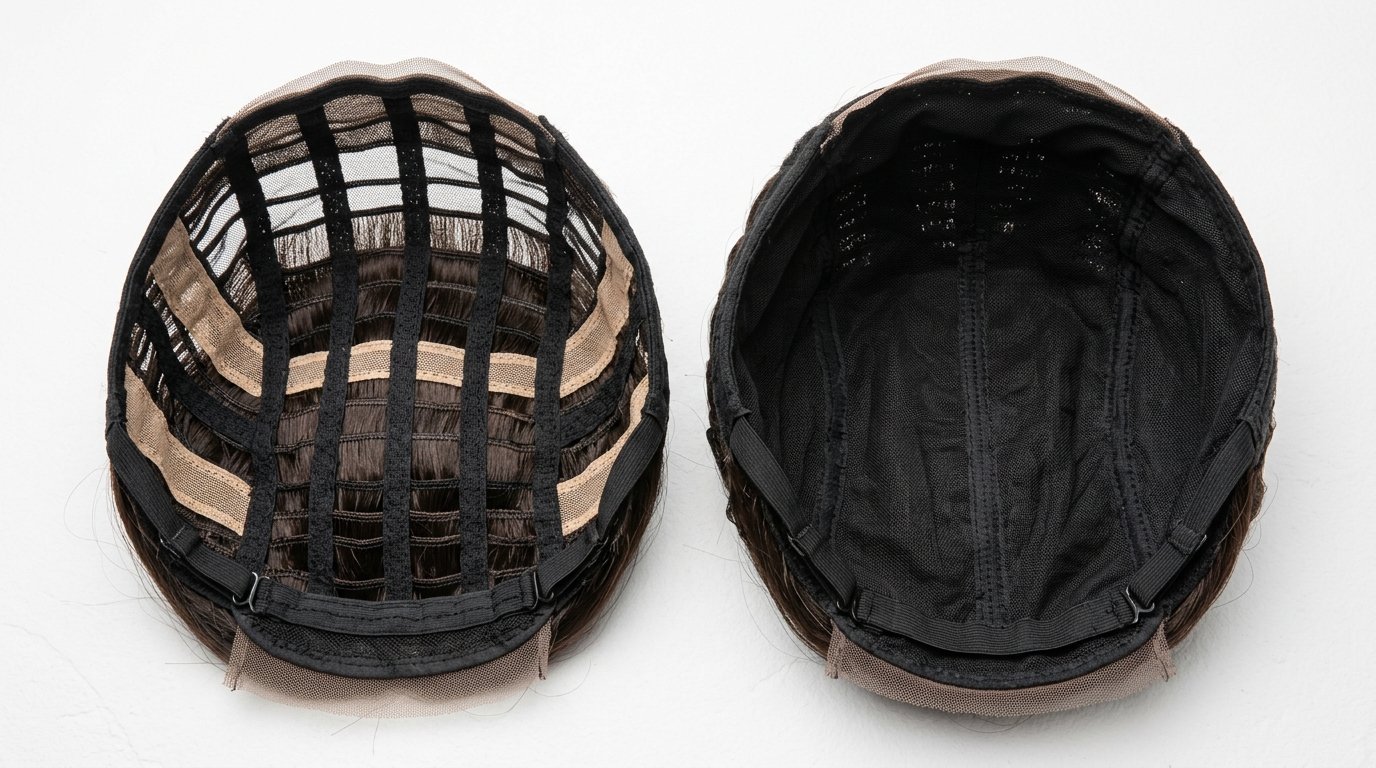
In a capless wig construction, the hair wefts (tracks of hair sewn together at the top) are attached to a lightweight framework of open strips and stretch panels rather than to a continuous, solid cap material. The result looks almost like a series of rows with open space between them rather than a solid surface. When you look at the inside of a capless wig, you see the rows of hair wefts with visible gaps between each row -- these gaps are the defining feature of capless construction and the source of all its practical advantages and disadvantages.
The framework that holds the wefts together typically uses:
- A reinforced perimeter band around the hairline and nape for structure and fit
- A center strip running crown to nape to anchor the top wefts
- Horizontal strips connecting the side sections
- Elastic stretch panels (usually at the sides and back) that conform to different head shapes without requiring precise sizing
Everything between these anchoring strips is open space, which is what gives capless wigs their signature breathability.
What Is a Traditional Cap Wig?
To understand capless construction, it helps to contrast it with a traditional cap wig. In a basic or standard cap wig, the hair is sewn onto a continuous, closed cap material -- typically a thin nylon or polyester mesh that covers the entire head from hairline to nape. There are no open spaces between the weft rows. The cap material forms a consistent surface across the full interior of the wig.
Traditional cap wigs are highly durable, hold their shape extremely well, and are easier to manufacture consistently, which is part of why they dominated the market for decades. The trade-off is the closed surface: on warmer days or during physical activity, the cap traps body heat and moisture against the scalp, making extended wear uncomfortable.
Capless Wigs vs. Cap Wigs: The Practical Differences
Breathability and Heat
This is where capless construction wins clearly and significantly. The open spaces between the weft rows in a capless wig allow air to circulate directly against the scalp. Heat and moisture can escape through these gaps rather than building up under a closed cap surface. In warm weather, during exercise, or for anyone who simply runs warm, the difference in wearing comfort between a capless wig and a closed cap wig is not subtle -- it can be the difference between a wig you can wear comfortably for eight hours and one you are ready to take off after two.
Weight
Capless wigs are lighter than comparable closed-cap wigs because there is less cap material. Less material touching the scalp means less weight distributed across the head, which reduces the fatigue that long wig-wearing sessions can cause -- particularly at the nape and temples where cap weight concentrates.
Fit Flexibility
The stretch panels built into most capless constructions give them more natural fit flexibility than rigid closed caps. Capless wigs tend to fit a wider range of head sizes acceptably without requiring specific sizing -- they conform to the head's shape through the elastic panels. This is why capless wigs are often sold without multiple size options: the stretch construction accommodates most adult head sizes within a single product.
Durability
Here is where closed cap wigs have a real advantage. Because a capless wig's structure relies on relatively narrow strips and elastic panels rather than a continuous cap surface, it has fewer structural attachment points for each weft. Over time and with heavy washing, the wefts in a capless wig can loosen and shift more readily than wefts sewn onto a solid cap. A closed cap wig, particularly one with hand-sewn wefts on a reinforced monofilament or poly cap, typically outlasts a capless construction under equal wear conditions.
Styling Flexibility
Capless wigs have a meaningful styling limitation: because the interior of the cap is open rather than closed, parts that extend deep enough to expose the cap interior will reveal the open construction -- visible strips and gaps rather than a natural-looking scalp. Capless wigs work best in styles where the hair falls naturally without a deep, exposed part. For natural-looking parts and scalp appearance, lace construction (lace front, lace closure, full lace) is the appropriate solution rather than capless construction.
Price
Capless wigs are generally less expensive than comparable closed cap wigs at the same hair quality level, because they use less cap material. This cost difference is more pronounced at the synthetic end of the market than in human hair, where the hair quality cost dominates the overall price more than the cap construction cost does.
Who Should Choose a Capless Wig?
Capless construction is the right choice when:
- Comfort and breathability during extended wear are the primary priorities
- You live in a warm climate or frequently wear your wig during physical activity
- Your scalp is sensitive or prone to sweating under a closed surface
- You are looking for a lighter, more affordable synthetic wig for everyday or occasional wear and do not need a natural-looking exposed part
- You have an average head size and want a wig that fits without precise sizing
Capless construction is less suitable when:
- You want to wear the wig in a style with a visible, natural-looking parting area
- Durability over a long wearing lifespan is the priority
- You have a significantly non-average head size (very small or very large) that needs precise cap sizing
- You are buying a premium human hair wig where the cap construction should support the hair investment with a longer lifespan
Common Cap Construction Types Compared
| Cap Type | Breathability | Natural Parting | Durability | Price |
|---|---|---|---|---|
| Capless | Excellent | Limited | Moderate | Lower |
| Basic Cap | Low | Limited | Good | Lowest |
| Lace Front Cap | Moderate | Natural front hairline | Good | Moderate-High |
| Monofilament Cap | Good | Natural anywhere on mono panel | Excellent | High |
| Full Lace Cap | Good | Natural anywhere | Moderate | Highest |
Frequently Asked Questions
Does a capless wig look different from the outside compared to a regular cap wig?
From the outside -- from the perspective of someone looking at you wearing the wig -- a capless wig and a closed cap wig are essentially indistinguishable. The cap construction is entirely interior; all that is visible from the outside is the hair itself. A capless wig with good hair quality, appropriate density, and a secure fit on the head looks the same from the outside as a closed cap wig with comparable hair. The differences are entirely experiential from the wearer's perspective -- the feel of air circulation on the scalp, the lighter weight, the ease of putting on without precise sizing -- rather than visible to observers. The one external exception is at the hairline, where lace or monofilament construction creates a more natural-looking edge than either capless or basic cap construction; but that is a property of the lace material itself, not of whether the overall cap is capless or closed.
Can a capless wig be glueless, and how does it stay on without glue?
Yes, capless wigs are generally well-suited to glueless wear, and they are typically designed with glueless installation in mind. Because capless caps use stretch panels and a perimeter band, they conform naturally to the head's shape with enough grip to stay in place during normal daily activities without adhesive. The elastic perimeter band sits snugly against the scalp, the stretch panels conform to the head curvature, and most capless wigs include adjustable straps at the nape to tighten or loosen the overall fit. For additional security, most capless wigs also have small pressure-sensitive combs sewn at the front, sides, and nape that clip onto the natural hair underneath. For everyday wear during normal activities -- working, walking, routine social situations -- the combination of elastic band, stretch panels, adjustable straps, and combs is entirely sufficient without any adhesive. The one situation where glueless capless wear becomes less reliable is in high-wind conditions or vigorous physical activity, where the slightly looser fit of an elastic-based cap can allow more movement than an adhesive-secured lace front would. In those situations, wig tape applied at the front edge or a simple elastic headband worn at the hairline provides the additional security needed without a full glue application.
If you are a wig retailer or distributor looking to source capless construction wigs alongside lace front and monofilament cap options at wholesale pricing, contact our sourcing team. We supply wigs across all cap construction types for retail businesses at competitive wholesale pricing.
WhatsApp: +86 17347350405
Email: hello@voretrade.com