Synthetic Wig Fibers Explained: What's Actually Inside Your Fiber Wig and Why It Matters
August 11, 2026 · Marcus Vore
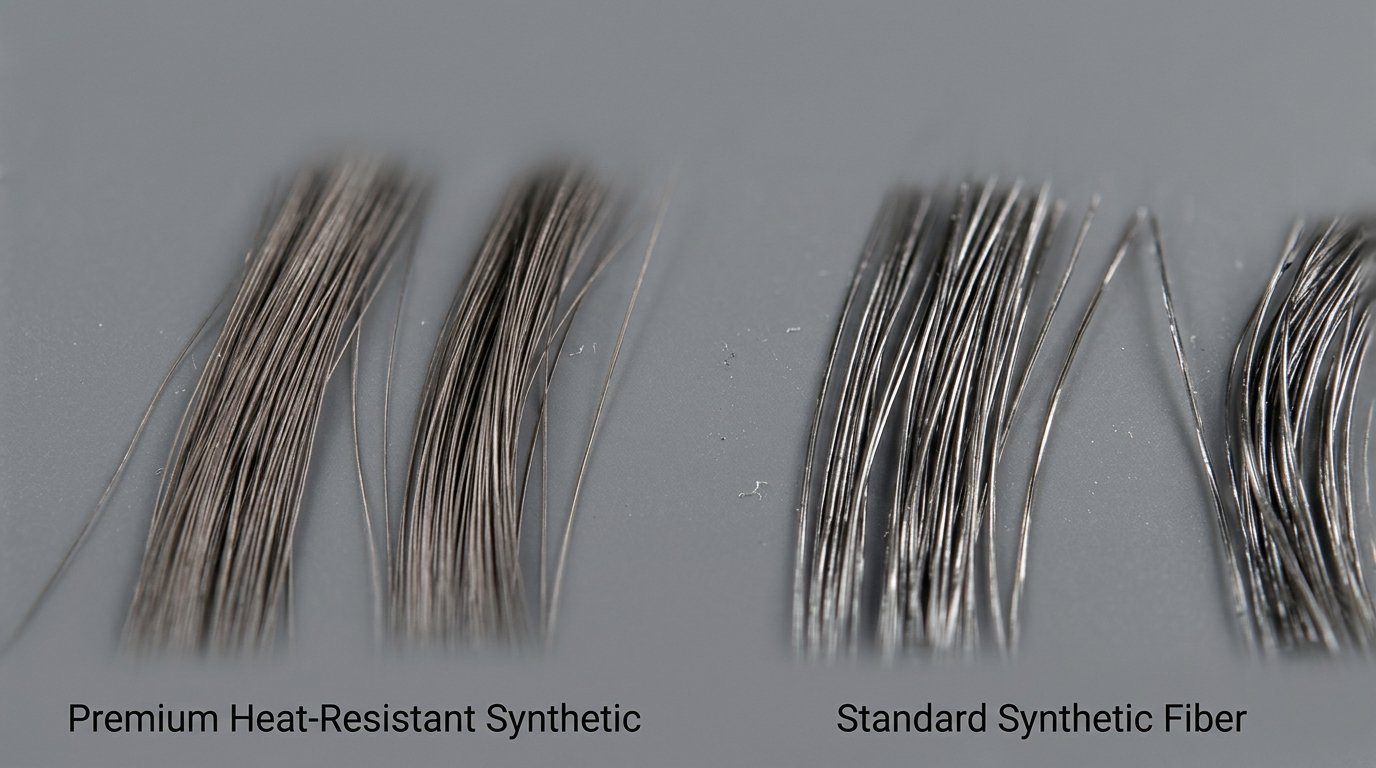
When you hold a synthetic wig in your hands, what you are actually holding is a textile product -- a manufactured polymer fiber engineered to look and behave like human hair. The quality of that fiber determines almost everything about your experience with the wig: how natural it looks, how it responds to heat, how long it lasts, how it reacts to humidity, and how it feels against your skin. Yet most people buying fiber wigs have almost no information about the fiber they are buying.
Product listings typically say "synthetic" or at most "high-quality synthetic." Neither tells you anything useful. This guide covers what synthetic wig fibers actually are, how they are made, the meaningful categories within the synthetic fiber market, and how to use this information when evaluating products.
What Synthetic Wig Fiber Actually Is
Synthetic wig fiber is a type of plastic polymer -- specifically a modacrylic fiber, which is a synthetic polymer made primarily from acrylonitrile modified with other compounds to achieve specific properties. The modacrylic polymer is extruded through small holes (spinnerets) to create continuous filaments, which are then cut, treated, and processed into the fiber used in wig construction.
The specific formulation of the polymer -- what compounds are used in the modification, the diameter of the extrusion spinneret, the drawing process that stretches the fiber -- determines its properties:
- The diameter of each filament determines the fiber's weight, drape, and texture feel
- The surface treatment applied to the fiber affects its sheen, smoothness, and how it reflects light
- The polymer formulation determines the fiber's heat resistance, its ability to hold a style set, and its resilience to mechanical stress
- The pigmentation applied to the fiber (usually through a solution dyeing process where colorant is mixed into the polymer before extrusion) determines color depth, UV resistance, and colorfastness
This manufacturing complexity is why synthetic fiber hair varies so significantly in quality between products at different price points -- and occasionally even between products at similar price points from different manufacturers.
The Main Categories of Synthetic Wig Fiber
Standard Modacrylic Fiber (Kanekalon and Generic Equivalents)
The most widely used fiber in synthetic wig production globally. Kanekalon is the best-known brand name -- it is a registered trademark of Kaneka Corporation, a Japanese chemical company that produces modacrylic fiber specifically for the hair product industry. Generic modacrylic fibers produced by other manufacturers follow similar formulations.
Standard modacrylic fiber in quality grades has a soft hand feel, good color stability, and acceptable sheen that reads as reasonably natural in most lighting. It is heat-sensitive -- most standard modacrylic fiber begins to soften and deform at temperatures around 175-200°F (80-93°C), which means it cannot be heat-styled with conventional hair tools without damage.
The quality range within "standard" modacrylic fiber is wide. Premium grades of Kanekalon fiber are genuinely good-quality material used in high-end fiber wigs and protective styling products. Generic low-grade modacrylic from other producers can be significantly inferior in texture and longevity despite being the same basic fiber category.
Heat-Resistant Synthetic Fiber (High-Temperature Modacrylic)
A modified modacrylic formulation with a higher glass transition temperature -- the point at which the polymer softens and deforms. Heat-resistant synthetic fiber (marketed under terms like "heat defiant," "heat resistant," "futura fiber," or specific brand names) can typically withstand temperatures from 300°F to 380°F (150°C to 193°C) without melting, allowing the use of curling irons, flat irons, and blow dryers on low-to-medium settings.
This is a genuinely useful property for buyers who want to style their wig with heat tools. However, it comes with trade-offs: heat-resistant fibers are typically somewhat coarser in texture than the finest standard fibers, and the modification required for heat resistance can sometimes produce a slightly different light reflection quality. As heat-resistant fiber technology has improved, the texture gap between heat-resistant and standard fibers has narrowed significantly, but a small difference often remains at comparable quality levels.
Toyokalon Fiber
A registered trademark fiber produced by Toray Industries, a Japanese chemical company. Toyokalon fiber is produced with finer strand diameters than standard Kanekalon and has historically been marketed as a premium alternative with a softer feel and more natural appearance. Toyokalon fiber is used in some higher-end wig products and in certain specialty braiding hair products where a finer, softer texture is specifically valued.
Human Hair-Like Synthetic Fibers (Premium Blends)
A category of synthetic fibers engineered to more closely replicate the appearance and texture of human hair than standard modacrylic. These fibers typically use finer strand diameters, more complex surface treatments that reduce uniform plastic sheen, and formulations that produce greater texture variation between individual strands -- all properties that contribute to a more natural appearance.
These premium fibers are used in the highest-quality synthetic wig fibers products -- high-end fashion wigs, professional theatrical wigs, and some medical hairpieces where natural appearance is critical. They are more expensive than standard synthetic fibers, and the price difference is generally reflected in the retail price of wigs that use them.
Silk-Touch and Velvet-Finish Fibers
Specialty surface-treated fibers designed to reduce the sheen of standard synthetic fiber and produce a more matte, softer-feeling surface. Standard synthetic fiber has a light reflection quality that can look plasticky, particularly in direct sunlight or bright indoor lighting. Silk-touch and velvet-finish treatments address this by modifying the surface at a micro level to scatter light more diffusely. Wigs using these fibers photograph better in most lighting conditions and look less obviously synthetic at close range.
What Fiber Properties Matter Most for Different Uses
The most important fiber properties vary depending on how you plan to use the wig:
For daily wear where natural appearance is the priority: Fiber diameter (finer = more natural), surface treatment quality (matte/silk-touch finishes over glossy), and color consistency (even distribution without patchiness) are the most important properties. Heat resistance is less important if you are wearing the wig in its pre-set style.
For heat styling flexibility: Heat resistance rating is the primary property. A specific temperature tolerance rating (e.g., "up to 350°F") is more useful information than a general "heat resistant" label, which could mean anything from 200°F to 400°F depending on the manufacturer.
For longevity under daily wear: Mechanical resilience of the fiber (its ability to withstand repeated bending, friction, and brushing without fraying or frizzing) matters most. This is harder to assess from product specifications alone -- genuine customer reviews over a 3-6 month period are the best indicator.
For outdoor and humidity-variable environments: Humidity resistance -- how much the fiber swells and frizzes when exposed to moisture in the air -- varies between fiber formulations. Some synthetic fibers are significantly more humidity-stable than others. This property is rarely specified in product listings but often appears in customer reviews as reports of frizzing in humid conditions.
Reading Fiber Specifications on Product Listings
What to look for and what to be skeptical of when evaluating product listings:
- "100% Kanekalon": A meaningful specification if accurate -- it identifies the fiber brand and implies a baseline quality standard. However, the term is sometimes used loosely by manufacturers for any modacrylic fiber, not just Kaneka's specific product.
- "High-quality synthetic": Meaningless as a specification. Every manufacturer describes their fiber this way regardless of actual quality level.
- "Heat resistant up to [temperature]": Useful and specific. A temperature rating gives you actionable information about what tools you can use.
- "Futura fiber": A term associated with heat-resistant synthetic fiber from specific manufacturers, but used inconsistently across the industry.
- No fiber specification at all: Common with budget products and a yellow flag -- brands that are confident in their fiber quality generally mention it.
Frequently Asked Questions
Why does my synthetic wig look great in the store but different at home in natural light?
This is one of the most common synthetic wig disappointments and it comes directly from fiber properties. Store lighting -- particularly the warm, diffused overhead lighting used in most beauty supply and retail environments -- is flattering to synthetic fiber because it minimizes the sheen differential between synthetic and natural hair. Natural daylight, and particularly direct sunlight, is far less forgiving. Daylight contains the full spectrum of visible light and illuminates the uniform, high-sheen surface of standard synthetic fiber in a way that indoor retail lighting does not. The same fiber that looks convincingly natural under store lighting can look noticeably plastic in direct sun. This is not a defect in the specific product -- it is an inherent property of standard modacrylic fiber. Addressing it requires buying from the silk-touch or premium fiber categories, or checking customer-uploaded photos specifically taken in outdoor or natural daylight conditions before purchasing. Brands and products where the customer photos in natural light look consistent with the product photography are using better fiber than those where a large gap exists between the two.
Can synthetic wig fiber be repaired or restored once it has started to frizz or degrade?
The honest answer is: partially, and only at earlier stages of degradation. The fundamental limitation is that synthetic fiber hair does not respond to the conditioning treatments that restore human hair, because its degradation is physical (the fiber surface is mechanically disrupted or heat-damaged) rather than chemical (the protein structure is damaged). For mild frizz in standard synthetic fiber: a diluted fabric softener treatment (soaking the frizzy sections in cool water with a small amount of fabric softener, then gently smoothing and allowing to air dry without disturbing) can temporarily flatten and smooth the fiber surface, reducing frizz. This is not a permanent repair -- the fiber has not returned to its original structure -- but it buys additional wearable life. For heat-resistant fiber with mild frizz: a flat iron set to a low temperature can smooth frizzy sections back to a straighter, smoother state. For severely degraded fiber -- matted sections, heavy frizz throughout, fiber that has been exposed to excessive heat -- no restoration approach is effective. The fiber structure at that stage is irreversibly damaged, and replacement of the wig rather than continued restoration attempts is the practical path. Buying higher-quality fiber at the outset, and following correct care practices (no brushing of curly styles, correct washing techniques, proper storage), is far more effective than any restoration approach after the fact.
If you are a wig retailer, wig manufacturer, or beauty supply business looking to source synthetic wigs across fiber quality tiers -- standard modacrylic, heat-resistant fiber, and premium fiber constructions -- at wholesale pricing, contact our sourcing team. We supply fiber wigs and synthetic hair products for retail businesses at competitive wholesale pricing.
WhatsApp: +86 17347350405
Email: hello@voretrade.com