Serving Hair Loss Clients: How Wigs Restore Confidence and Build Your Business
May 1, 2026 · Marcus Vore
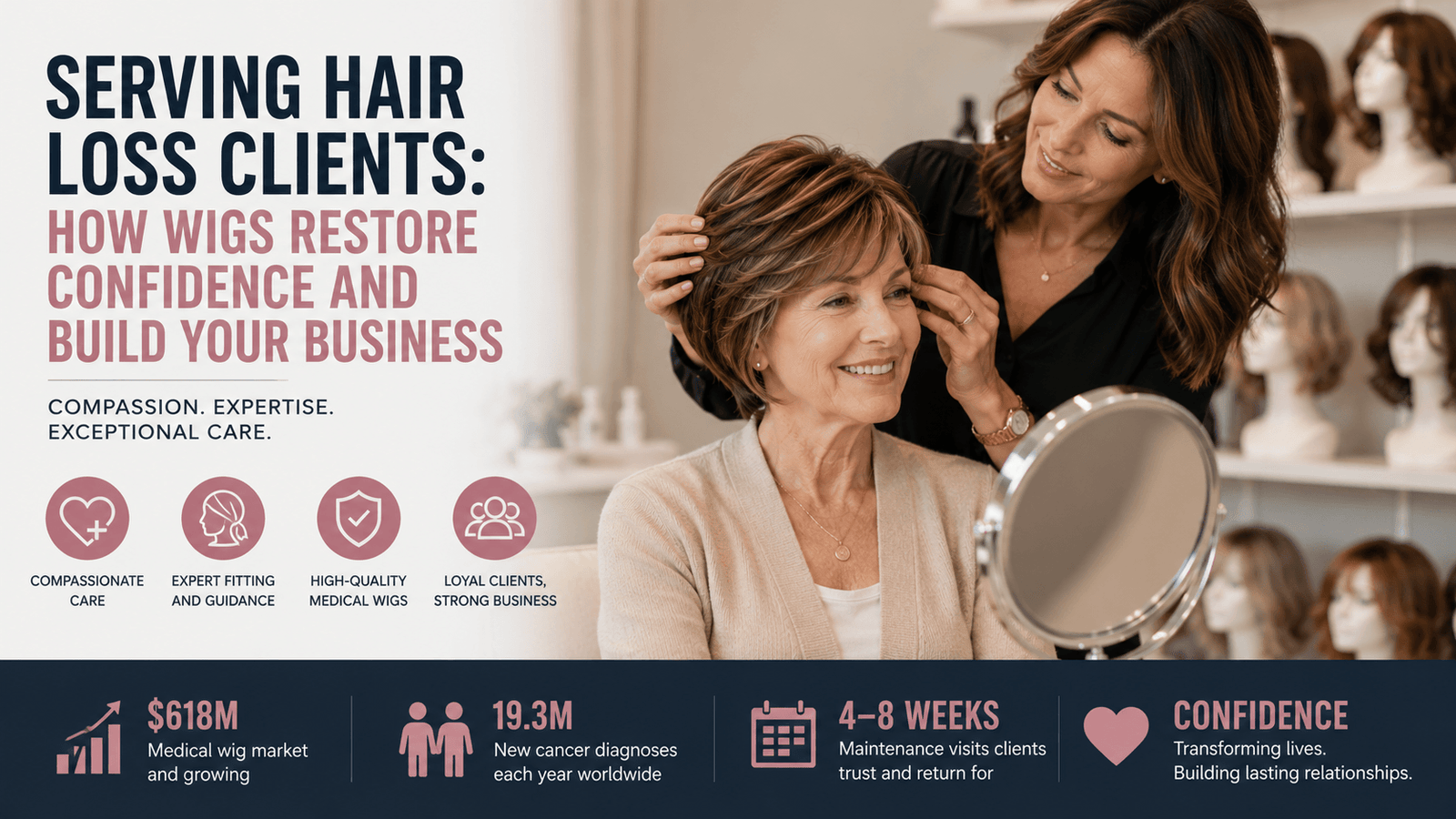
To serve hair loss clients profitably, stock wigs with hand-tied or monofilament caps, keep both human hair and heat-friendly synthetic options, and set up a private consultation space. The medical wig segment is worth $618 million globally and growing at 6.2% annually, yet most salons and retailers ignore it entirely. Here is how to capture that demand.
A client named Maria walked into a salon in Atlanta last year. She removed her scarf to reveal complete hair loss from chemotherapy. The stylist froze. She had never fitted a bald client before. She did not know which cap type would be comfortable on a sensitive scalp or whether synthetic or human hair made more sense. Maria left without a wig. She never came back.
That salon lost more than a sale. It lost a client who would have returned every 4-6 weeks for maintenance, referred other patients from her support group, and spent $400-800 per visit. Hair loss clients are among the most loyal and least price-sensitive customers in the wig industry, if you know how to serve them.
Key Takeaways - Medical wig clients spend $400-800 per unit and return every 4-8 weeks for maintenance, generating more lifetime value than fashion wig buyers - Stock hand-tied and monofilament cap wigs for sensitive scalps; avoid combs and rough seams that irritate bare skin - Heat-friendly synthetic wigs work best for chemotherapy patients (low maintenance during treatment fatigue); human hair suits long-term alopecia clients - A private fitting room, flexible scheduling, and empathy-first language matter as much as product selection - Your supplier relationship determines your reputation, inconsistent density or wrong cap materials will get blamed on you, not the factory
Why the Hair Loss Market Matters for Your Business
The Numbers Behind the Need
The global wig and hair extension market hit $7.6 billion in 2025 and is projected to surpass $13 billion by 2031. Medical wigs alone account for roughly $618 million of that, growing at a steady 6.2% annually according to Congruence Market Insights. This is not a niche; it is a substantial, growing segment that most wig businesses overlook.
The demand drivers are not seasonal. Every year, 19.3 million people worldwide receive a cancer diagnosis, and chemotherapy-induced hair loss remains the single largest driver of medical wig purchases at roughly 55% of the segment. Add to that alopecia areata affecting approximately 2% of the global population according to the National Alopecia Areata Foundation, stress-related hair thinning rising post-pandemic, and an aging population, and you have steady, year-round demand that does not depend on fashion trends or Instagram influencers.
The US wig market alone reached $940 million in 2024, growing at nearly 15% annually according to ShelfTrend. Within that, the medical sub-segment is the fastest-growing application category.
Why These Clients Build Your Business
Fashion wig buyers chase trends. They comparison-shop. They might buy from you once and then try a different brand next month because an influencer recommended it.
Medical wig clients are different. When someone with alopecia or chemotherapy-induced hair loss finds a wig that makes them feel like themselves again, they become fiercely loyal. They return for maintenance. They tell their support groups. They stop price-shopping because trust and comfort outweigh a $20 discount.
Consider the unit economics: a fashion wig client might spend $80-150 once or twice a year. A medical wig client typically spends $400-800 on their first fitted unit, returns every 4-8 weeks for cleaning, adjustment, and restyling at $50-100 per visit, and often buys a second unit within 6 months. First-year value frequently exceeds $1,200, and that is before referrals.
Ready to add medical wigs to your inventory? Request wholesale pricing and samples →, we will help you choose the right cap types and densities for your market.
Medical Wigs vs. Fashion Wigs: What You Need to Stock
Cap Features That Matter for Sensitive Scalps
A fashion wig sits on a head with hair. A medical wig sits on bare, often sensitive skin. The differences are not marketing fluff, they are functional requirements that determine whether your client can wear the wig comfortably for 8+ hours.
Medical-grade wigs prioritize four things that fashion wigs often compromise on:
Soft inner lining. Look for bamboo, silk, or cotton linings sewn into the cap interior. These materials wick moisture and prevent the itching that synthetic cap bases can cause on bare scalps.
Silicone grip strips instead of combs. Most fashion wigs use small plastic combs at the temples and nape to anchor the wig to natural hair. On a bald client, those combs dig into skin. Medical wigs use medical-grade silicone strips that grip gently without irritation.
Breathable cap construction. A client wearing a wig through a full workday or during cancer treatment (which can cause hot flashes) needs airflow. Open-wefted backs and lightweight lace materials make a meaningful difference in all-day comfort.
Adjustable straps with extra range. Head circumference can shrink by up to a full size during chemotherapy. A wig that fit perfectly at the first fitting may be loose two months later. Adjustable straps with a wide range handle this without requiring a new unit.
Human Hair vs. Synthetic for Hair Loss Clients
The choice is not "which is better." It is "which suits this client's situation right now."
| Factor | Human Hair | Heat-Friendly Synthetic |
|---|---|---|
| Best for | Long-term alopecia clients, daily multi-year wear | Chemotherapy patients, first-time wig wearers |
| Lifespan | 1-3 years with proper care | 4-8 months with daily wear |
| Maintenance | Wash, condition, style weekly | Wash every 6-8 wears, air dry |
| Styling flexibility | Cut, color, heat-style freely | Limited heat styling (typically up to 350F) |
| Weight | Heavier | Lighter, easier for treatment fatigue |
| Wholesale cost | $45-120 per unit | $20-50 per unit |
| Retail price | $300-1,200+ | $80-400 |
For chemotherapy patients, synthetic often wins. Someone going through treatment does not have the energy to wash, condition, and style a human hair wig. A heat-friendly synthetic unit comes pre-styled, holds its shape after washing, and weighs less, all real advantages during months of treatment.
For long-term alopecia clients who will wear the same wig daily for years, human hair delivers the durability, styling flexibility, and natural movement that justifies the higher cost. Many clients eventually own both: a synthetic unit for daily convenience and a human hair unit for occasions.
Wig Cap Types: Matching Construction to Medical Needs
The cap is the part your client feels all day. Getting this right matters more than the hair type.
| Cap Type | Comfort Level | Best Use Case | Wholesale Price Impact |
|---|---|---|---|
| Hand-tied | Highest, each hair individually knotted, lightest feel | Total hair loss, sensitive scalps, daily all-day wear | +$15-30 vs. basic cap |
| Monofilament | High, fine mesh mimics scalp, breathable | Partial hair loss, natural-looking part line | +$10-20 vs. basic cap |
| Lace front | Medium-high, sheer hairline, undetectable front | Clients who wear hair pulled back, need natural hairline | +$5-15 vs. basic cap |
| Full lace | Medium, entire cap is lace, maximum styling | Updos, ponytails, high styling flexibility | +$20-40 vs. basic cap |
| Wefted/basic | Lower, rows of sewn hair, visible at part | Budget-conscious clients, short-term use | Base price |
For most hair loss clients, a combination cap works best: monofilament top for a natural part and scalp appearance, lace front for an undetectable hairline, and wefted back for breathability and cost efficiency. Pure hand-tied caps are ideal but add $15-30 to your wholesale cost, pass that through with clear explanation of the comfort difference.
What not to stock for medical clients: Avoid heavy caps with thick seams across the crown (irritates bare scalps), caps that rely entirely on comb attachments (useless on a bald head), and caps with visible knotting at the hairline (destroys the natural look your client needs to feel confident).
The Consultation: Fitting a Client with Hair Loss
Creating the Right Environment
The consultation experience matters as much as the product. A client with chemotherapy-induced hair loss or alopecia universalis is often vulnerable, self-conscious, and nervous. They may never have worn a wig before.
Set up a private fitting room with a door that closes, not a curtain, not a corner of the salon floor. Schedule longer appointment slots (90 minutes minimum for a first fitting) and offer flexible rescheduling for clients whose treatment side effects flare unpredictably.
One salon owner in Manchester, James, told us he nearly lost his first medical wig client because he kept her waiting in the main salon area while finishing another appointment. She sat there, bald under a scarf, watching women with full heads of hair get blowouts. She felt exposed. Now James books medical clients as the first appointment of the day, before the salon gets busy. His medical wig business has tripled in 18 months.
The Fitting Process Step by Step
Measuring a bald head. The process is the same as measuring a head with hair, circumference, front to nape, ear to ear over the top, temple to temple around back, but you cannot use hair as a reference point. Use a flexible measuring tape directly against the skin. Write down all four measurements. Cap sizes run petite (21-21.5 inches), average (22-22.5 inches), and large (23-23.5 inches).
Remember that a client undergoing chemotherapy may lose weight and experience head size reduction of up to a full size over 2-3 months. Fit snug but not tight on the first visit, and schedule a follow-up adjustment at 6-8 weeks.
Color matching without natural hair. If your client still has hair at the first consultation, match to the root color, not the ends. If all hair is gone, ask for photos of their natural hair before loss. If photos are not available, match to eyebrow color as the closest reference. Go one shade lighter if in doubt; chemotherapy can make skin tone paler, and a wig that is slightly lighter looks more natural than one that is too dark.
Setting expectations. A client who has never worn a wig may expect it to feel like their natural hair. It will not, at least not immediately. Tell them honestly: the first few days feel unfamiliar. By week two, most clients stop noticing the cap. By week four, they forget they are wearing it. Setting this timeline upfront prevents the panic of "this does not feel right" on day one and the return that follows.
What to Say, and What Never to Say
Use language that centers the client's goals, not their condition. Ask "what kind of look are you going for?" not "what are you trying to cover up?" Say "this cap is designed for sensitive skin" not "this is for bald people." Say "let's find the right fit for your head shape" not "don't worry, it covers everything."
A stylist in Toronto, Priya, keeps a simple phrase in her consultation toolkit: "Let's find the wig that makes you feel like you again." She says it at the start of every first fitting. Clients regularly mention that line in their Google reviews, it is the reason they chose her salon.
Need cap construction samples to show your clients? We can send monofilament, hand-tied, and lace front comparison pieces so clients can feel the difference. WhatsApp us for sample pricing →
Sourcing Medical-Grade Wigs: What Your Supplier Must Deliver
Finding a supplier who can consistently meet medical-grade specifications is harder than finding one for fashion wigs. The requirements are tighter. The consequences of failure are higher. Our guide on how to find reliable suppliers in China covers the vetting process in detail, but here are the medical-wig-specific standards that matter most.
Quality Specs That Actually Matter
When you order fashion wigs, a small inconsistency in density or lace color might generate a return or a 3-star review. When you order a wig for a chemotherapy patient, that same inconsistency can break someone's confidence on a day they desperately needed to feel normal. The stakes are higher, and your quality standards need to match.
Here is what to specify and verify with every medical wig order:
Density consistency across batches. Order 150% density, receive 150% density, not 130% on one batch and 170% on the next. The weight test catches this: a 16-inch 150% density wig should weigh approximately 150-170 grams. Weigh every sample. Weigh spot checks from every bulk order.
Cap material certification. Request OEKO-TEX or equivalent certification for cap materials. This verifies the fabric and silicone components are free from harmful chemicals, critical for clients whose immune systems may be compromised during treatment.
Knot bleaching and lace color. The lace at the hairline must match the client's scalp tone. Medium brown lace on a fair-skinned client looks like a visible grid on their forehead. Transparent HD lace works across the widest range of skin tones, but Swiss lace requires more precise color matching. Specify lace shade by Pantone or supplier color code, not by description like "light brown."
Pre-shipment photos from multiple angles. Demand hairline close-ups, crown part shots, and interior cap photos under natural lighting before every shipment. A supplier who will not provide these is hiding something, walk away.
Red Flags When Choosing a Wig Supplier
A supplier who says "our quality is guaranteed, no need to check" is not guaranteeing anything. Legitimate suppliers welcome verification. Watch for these warnings:
- Refuses to send physical samples before bulk order. Every legitimate factory provides samples. Pay for them yourself so the supplier has no incentive to send a "sample quality" batch that differs from production.
- Cannot explain their cap construction process. If they cannot tell you whether the cap is single-knotted or double-knotted, hand-tied or machine-wefted, they are a trader reading from a catalog, not a manufacturer who controls quality.
- Lace color varies significantly between sample photos. Light in one photo, dark in another, different color temperature each time? They are showing you different batches from different production lines. Quality will be inconsistent.
- Density claims do not match weight. We have already covered the weight test. Use it every time.
A supplier relationship is not about finding the cheapest unit price. It is about finding a partner whose quality you can stake your reputation on, because when a hair loss client receives a bad wig, they do not blame the factory in Xuchang. They blame you.
Building a Profitable Medical Wig Service Line
Pricing Models That Work
Medical wig services command premium pricing, but you need to structure your offerings clearly so clients understand what they are paying for.
| Service Tier | What is Included | Price Range | Rebook Cadence |
|---|---|---|---|
| Ready-to-wear install | Stock unit, basic fitting, trimming | $200-400 | 2-4 weeks |
| Semi-custom | Cut, color, style to client preference | $400-700 | 4-8 weeks |
| Full custom build | Made to client head mold, custom density/length/color | $600-1,200+ | 6-12 weeks |
| Maintenance membership | Cleaning, restyling, adjustment, cap inspection | $50-150/month | Monthly |
The maintenance membership is where the predictable revenue lives. A client on a $75/month plan who stays with you for 3 years generates $2,700 in recurring revenue, on top of the initial unit sale. Ten such clients is $27,000 in annual recurring revenue from maintenance alone.
Insurance billing adds a revenue layer. In the US, many private insurers cover one cranial prosthesis per year under billing codes A9282 or S8095. A client who knows their insurance will reimburse $500-800 for a medical wig is far less price-sensitive. Learn the billing process or partner with a medical billing service. The client needs a prescription from their oncologist or dermatologist with the ICD-10 diagnosis code and an itemized receipt from you.
Marketing to Hair Loss Clients Without Being Exploitative
This is the line you cannot cross. Marketing medical wigs requires a tone that acknowledges real suffering without exploiting it. "Get your confidence back" is fine. "You look terrible without hair, buy our wig" is obviously not.
The most effective marketing channels for medical wig clients are relationships, not ads:
- Partner with local oncology centers and dermatology clinics. Leave brochures, business cards, and a sample cap swatch book with the nursing staff. When a patient asks "where do I get a wig?" your name should be the first answer.
- Connect with alopecia support groups and cancer survivor networks. Attend meetings as a resource, not a salesperson. Offer a free 15-minute consultation. One client from a support group typically refers 3-5 others.
- Create content that answers real questions. "How to prepare for hair loss before chemo starts" and "What no one tells you about wearing a wig during treatment" are articles that get shared in patient communities. Write them.
- Show before-and-after transformations with client permission. These are the most powerful marketing assets you have. A photo of a client smiling after their fitting communicates more than any ad copy.
The medical wig market does not respond to urgency tactics or discount codes. It responds to trust, referrals, and demonstrated competence. Build those, and the business follows.
Frequently Asked Questions
What type of wig is best for a client with total hair loss? A hand-tied or monofilament cap with silicone grip strips and a soft inner lining. Avoid combs and heavy wefting. Heat-friendly synthetic is often the best starting point for chemotherapy patients; human hair suits long-term daily wear for alopecia.
How much should I charge for a medical wig fitting? Build the fitting fee into the unit price rather than charging separately. Clients perceive better value from "wig + fitting included at $500" than "$350 for the wig plus $150 fitting fee." Maintenance services can be itemized separately.
Do cancer patients prefer human hair or synthetic wigs? Most start with synthetic. It is lighter, pre-styled, and requires almost no maintenance, all advantages during months of treatment where energy is limited. Some upgrade to human hair after treatment ends and they are ready for a longer-term daily wear option.
How do I partner with oncology centers? Start by asking to speak with the patient navigator or social worker. Bring a sample cap swatch book and leave professional materials (brochures, cards). Offer to give a free 15-minute educational session for nursing staff on what to tell patients about wig options. Do not lead with a sales pitch.
What insurance codes cover wigs for medical hair loss? In the US, cranial prostheses are billed under HCPCS codes A9282 or S8095. The client needs a prescription from their treating physician with the ICD-10 diagnosis code. Not all insurers cover these codes, and coverage caps vary. Always have the client verify with their insurer before purchasing.
How long does it take to ship medical-grade wigs from China? Express courier (DHL/FedEx): 3-7 days. Air freight: 7-15 days. Sea freight: 20-45 days. For first orders, we recommend express courier to evaluate quality before committing to the cost savings of sea freight on bulk. Read our complete shipping guide for a full breakdown.
Build Your Medical Wig Business with a Supplier You Can Trust
The medical wig market is a $618-million segment growing steadily year over year, driven by demand that does not depend on fashion cycles or social media trends. The clients are loyal. The margins are healthy. The work is genuinely meaningful, you are helping someone feel like themselves again during one of the hardest periods of their life.
But none of that matters if your supplier sends inconsistent quality. When a chemotherapy patient opens a box expecting a 150%-density lace front in medium brown and finds a 130%-density unit with dark lace, your reputation takes the hit. Not the factory's.
That is why we built our 4-step verification process: factory audit, sample approval, production QC, and pre-shipment inspection with photos and videos sent to you before every shipment. You approve what you see, or we fix it before it leaves China.
Ready to add medical wigs to your inventory? Tell us your target market and we will recommend cap types, densities, and price points that work for your specific customers.
- WhatsApp: +86 17347350405 (fastest response)
- Email: hello@voretrade.com
No commitment needed. Just a conversation about what your clients need and whether we can supply it.