Leave-In Conditioner for Wigs: What Works for Human Hair Wigs and Why Your Wig Needs It More Than You Think
August 12, 2026 · Marcus Vore
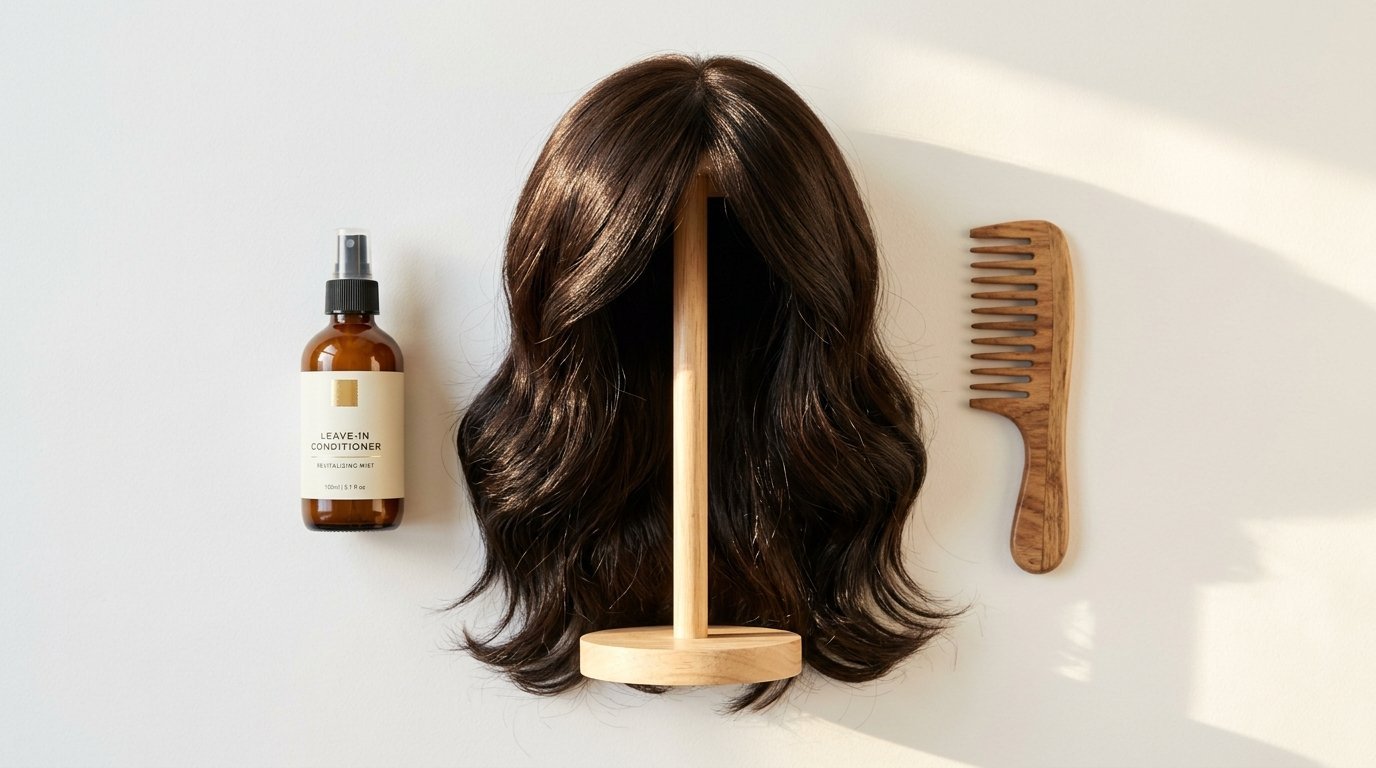
One of the most common mistakes human hair wig owners make is treating their wig the same way they treat their natural hair for moisture -- which means not treating it enough. Natural hair receives a constant supply of sebum from the sebaceous glands at each follicle. That sebum travels down the hair shaft over time, conditioning the hair from root to end as a continuous, automatic process. A human hair wig has no follicles, no sebaceous glands, and no automatic moisture supply. It receives only what you deliberately give it.
This is why leave in conditioner for wigs matters more than most care guides emphasize. A rinse-out conditioner during washing provides temporary moisture that largely washes out with the rinse water. A leave in conditioner for human hair wigs, applied correctly between washes and after washing, provides ongoing moisture retention that keeps the hair soft, manageable, and far less prone to the breakage and tangles that dry hair develops.
Why Human Hair Wigs Dry Out Faster Than Natural Hair
Beyond the absence of scalp-supplied sebum, several factors make wig hair drier than equivalent natural hair:
- Processing history: Human hair used in wigs has typically been processed -- washed, treated, sometimes colored or permed -- before construction. Each processing step opens the cuticle and removes some of the hair's natural moisture. A wig made from even the highest-quality Remy hair starts life more processed than your own natural hair.
- Washing frequency: Well-maintained wigs are washed regularly to remove product buildup and environmental debris. Each wash, even with gentle shampoo, removes some moisture that natural hair would partially replenish through sebum production before the next wash.
- Heat styling exposure: Any heat styling -- blow drying, flat ironing, curling -- accelerates moisture loss in the hair. Without ongoing scalp oil production to compensate, the cumulative effect on a wig is more significant than on natural hair exposed to the same amount of heat.
- Environmental exposure: Wigs worn outdoors are exposed to UV, wind, and humidity changes. UV specifically degrades hair protein structure and accelerates moisture loss. Natural hair has the scalp's oil layer as partial UV protection; wig hair has only what is applied.
What to Look for in the Best Leave-In Conditioner for Human Hair Wigs
Not all leave-in conditioners perform equally well on wig hair. The best leave in conditioner for human hair wigs should have a specific combination of ingredient types:
Humectants (For Attracting Moisture)
Humectants draw water molecules from the surrounding environment into the hair shaft, increasing the hair's water content. Key humectants to look for:
- Glycerin: One of the most effective humectants available and very well-tolerated by most hair types. Works best in moderate humidity environments.
- Panthenol (Pro-Vitamin B5): Penetrates the hair shaft to improve moisture retention from within rather than just coating the surface.
- Aloe vera: A natural humectant with additional soothing properties, particularly useful for wigs worn against scalp skin.
- Hyaluronic acid: An increasingly common inclusion in hair care, effective at attracting and holding water in the hair structure.
Emollients (For Softening and Smoothing)
Emollients fill gaps in the hair cuticle, smoothing the surface and creating a softer feel. In wig hair where the cuticle may be slightly lifted from processing, emollients are particularly important:
- Natural oils (argan, jojoba, avocado): Penetrate the hair shaft to some extent and also coat the surface. Argan oil is particularly well-suited to wig care because it provides both moisture and shine without the greasiness of heavier oils.
- Silicones (dimethicone, cyclomethicone): Create an extremely smooth surface coating that reduces friction between strands, reducing tangling. Light silicones (cyclic silicones) are easier to remove during washing than heavier ones (dimethicone).
- Cetyl alcohol or cetearyl alcohol: Fatty alcohols that soften and smooth hair without drying it -- note that fatty alcohols are conditioning, unlike drying alcohols (ethanol, isopropyl) which should be avoided in wig care products.
Proteins (For Strength and Damage Repair)
Hydrolyzed proteins temporarily fill gaps in damaged cuticle and strengthen hair that has been weakened by processing. For wig hair:
- Hydrolyzed keratin: Particularly appropriate for human hair wigs since it matches the hair's own protein structure
- Hydrolyzed silk or wheat protein: Smaller protein molecules that can penetrate deeper into the hair structure for more internal repair
Avoid leave-in products with high concentrations of drying alcohols (ethanol, isopropyl alcohol, SD alcohol) as these will work against the moisture goals of the treatment.
Recommended Products: Best Leave-In Conditioner for Human Hair Wigs
These formulations have proven track records in the wig care community:
- Kenra Platinum Silkening Mist: A lightweight leave-in spray with a balanced formula of conditioning agents and heat protection. Adds exceptional shine to human hair wigs without heaviness or buildup. Works particularly well on straighter wig textures.
- Olaplex No. 6 Bond Smoother: A reparative leave-in that works specifically on the disulfide bonds in hair that are damaged by processing and heat. Particularly valuable for wigs that have been heat-styled repeatedly or for wigs made from previously processed donated hair.
- Moroccanoil Treatment: The argan oil-based lightweight treatment that has become a staple for wig maintenance. Used in very small amounts, it adds softness, shine, and frizz control without making wig hair feel greasy. Works well on wavy and textured human hair wigs.
- CHI Silk Infusion: A silicone-based leave-in that provides exceptional smoothness and tangle prevention. Particularly effective for long human hair wigs where tangling at the ends is an ongoing challenge.
- Camille Rose Curl Love Moisture Milk: A richer leave-in for wigs with curly or wavy textures where more substantial moisture is needed to maintain curl definition and prevent frizz.
The right product depends on your specific wig texture, its current condition, and your climate. Fine, straight wigs need lighter leave-ins than thick, curly ones. Dry climates require more humectant-heavy formulas; very humid climates may need lighter formulations that do not attract excess atmospheric moisture.
How to Apply Leave-In Conditioner to a Wig Correctly
Application method affects the results significantly:
- Apply to damp hair, not soaking wet or bone dry: Leave-in conditioner is most effective applied to slightly damp hair -- after washing and gently blotting with a microfiber towel, not after air drying completely. The slight dampness allows the product to distribute more evenly and penetrate more effectively than application to either extreme.
- Apply to sections, working from ends to mid-shaft: Apply the product to the ends and mid-lengths first, which are the driest parts of the wig and need the most moisture. Apply less to the area near the cap, where product can accumulate and cause the cap attachment area to feel heavy or sticky over time.
- Use a wide-tooth comb to distribute evenly: After applying, use a wide-tooth comb (starting from the ends and working upward) to distribute the product evenly through the hair while gently detangling. This ensures full coverage without clumping.
- Do not rinse out: Leave-in conditioner stays in the hair. Allow the wig to air dry on a wig head after application rather than rinsing.
- Apply lightly between washes too: A light mist of leave-in spray between wash sessions helps maintain moisture between full treatments, particularly in dry weather or after wearing the wig in air-conditioned environments.
Leave-In Conditioner for Synthetic Wigs: A Different Approach
Synthetic wigs need different treatment. Standard leave-in conditioners designed for human hair have limited effect on synthetic fiber because the conditioning mechanisms (moisture absorption into the hair shaft, protein bonding to keratin) simply do not apply to plastic polymer fiber. For synthetic wigs, diluted fabric softener (1 tablespoon of fabric softener in 2 cups of water, applied as a light mist and allowed to air dry) is the most cost-effective approach for restoring softness and reducing static. Purpose-formulated synthetic wig conditioners from brands like It's a 10 or CHI also work well. The goal with synthetic is surface softening, not moisture penetration -- the approach is different from human hair care.
Frequently Asked Questions
How often should I apply leave-in conditioner to my human hair wig?
The honest answer is: more often than most people do. A full leave-in conditioner application after every wash is the baseline -- that means every 1-2 weeks for a regularly worn wig. Beyond that, a light mist of leave-in spray every 2-3 days of wear helps maintain moisture between wash sessions, particularly if the wig is worn in dry indoor environments (air conditioning and central heating both reduce air humidity significantly, accelerating moisture loss from wig hair). If you notice the wig beginning to feel rough to the touch, becoming increasingly difficult to detangle, or looking dull and lacking its normal sheen, these are signs that moisture maintenance has fallen behind and a more intensive treatment -- either a deep conditioning treatment left on for 20-30 minutes before washing, or a nightly light oil treatment -- is needed to bring the hair back to good condition. The goal is consistent prevention rather than correction -- it is much harder to restore significantly degraded wig hair than to prevent degradation through regular, light moisture maintenance.
Can I use a leave-in conditioner designed for natural curly hair on my curly human hair wig?
Yes, with good results in most cases. Leave-in conditioners formulated for naturally curly hair tend to be richer in moisture, more generous with humectants, and more specifically formulated to enhance and maintain curl pattern -- all of which are appropriate for curly human hair wigs that have the same structural needs as naturally curly hair. The slight caveat: some products formulated specifically for naturally curly hair include ingredients targeted at scalp health (certain botanicals, carrier oils applied at the scalp level) that serve no function on a wig but do no harm either. More practically, very heavy creamy leave-ins designed for extremely dry or coarse natural curly hair may be too heavy for lighter or finer curly wig textures, causing the curls to become weighed down rather than defined. As a practical guide: if the product is formulated for "fine to medium natural curls," it is likely appropriate for most curly human hair wig textures. If it is formulated for "very dry, coarse, or 4C natural hair," test on a small section of the wig first to ensure the weight and richness of the formula is appropriate for your specific wig texture before applying throughout.
If you are a wig retailer or beauty salon looking to source human hair wigs alongside the care products that help customers maintain them, contact our sourcing team. We supply human hair wigs at wholesale pricing for retail businesses.
WhatsApp: +86 17347350405
Email: hello@voretrade.com