Human Hair Wiglets: What They Are, How They Differ from Full Wigs, and Why Real Hair Makes All the Difference
August 14, 2026 · Marcus Vore
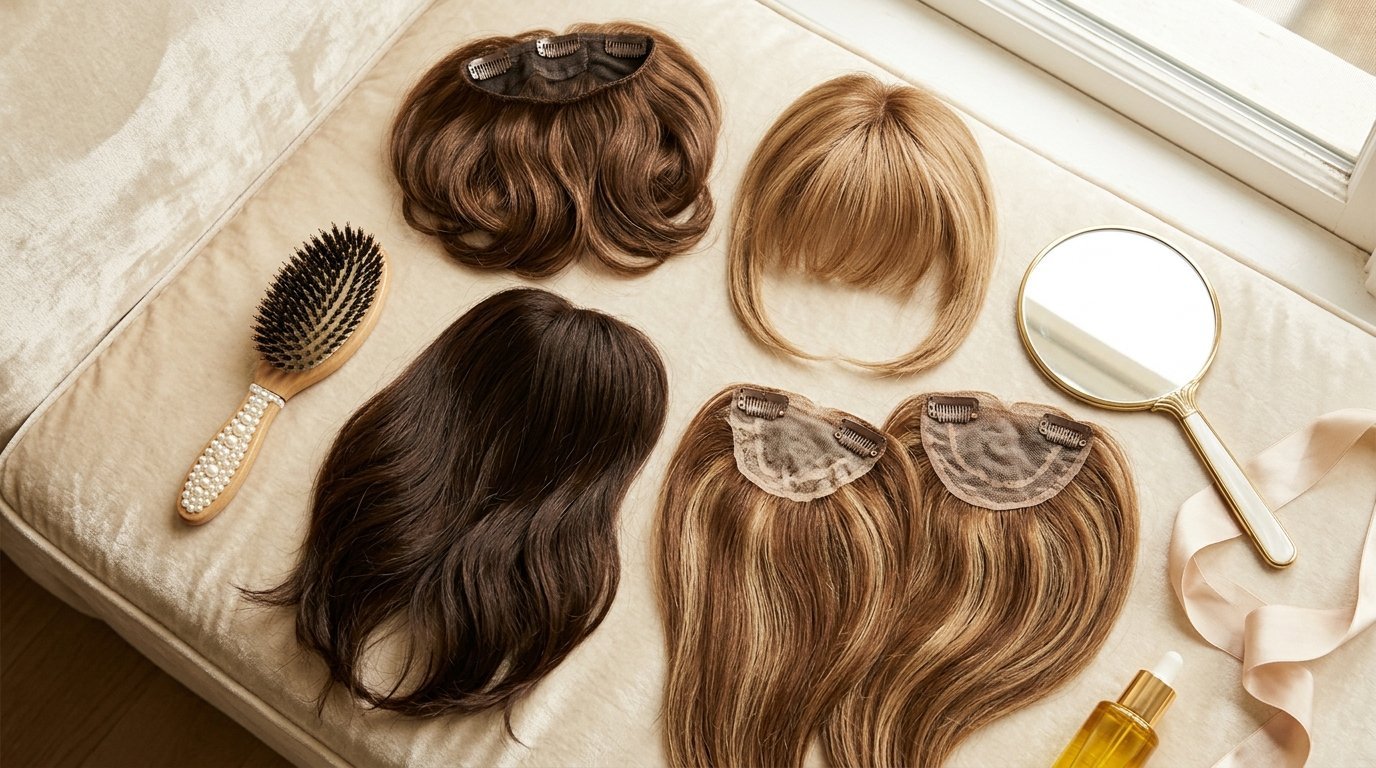
The term wiglet is one of the less standardized in the hair alternative market -- different retailers use it to describe slightly different products, which creates confusion for buyers trying to understand what they are actually purchasing. In the most common usage, a wiglet wig is a partial hairpiece designed to be worn with your own natural hair showing at the front, adding volume, length, or density to the top and back sections where natural hair is most commonly thin or sparse. It is smaller than a half wig, larger than a clip-in extension, and more structured than a traditional hairpiece.
This guide clarifies exactly what hair wiglets are, explains why wiglets real hair construction matters, and covers where wiglets fit in relation to luxury human hair wigs and other hair alternatives.
What Is a Wiglet? Defining the Category Clearly
A wiglet hair piece is a partial wig that typically covers the crown and top section of the head -- the area from roughly the mid-scalp back to the nape, or from the crown to the sides, depending on construction. The key characteristic is that it is designed to be worn with natural hair blended in at the front hairline and temples, creating the appearance of a complete, full hairstyle without covering the entire head.
Common wiglet constructions include:
- Crown wiglets: Clip-in or comb-secured pieces covering only the crown area, adding volume at the top where hair is often thinnest
- Top pieces: Slightly larger pieces covering from the front hairline back to the crown, with the wearer's natural hairline and temples showing
- 3/4 wigs (three-quarter wigs): The largest wiglet format, covering from roughly the ear-to-ear line back, leaving only the very front of the natural hairline exposed
- Chignon wiglets: Structured pieces for the back of the head that create the appearance of an updo or gathered style without requiring enough natural hair length to achieve the look independently
Human Hair Wiglets vs. Synthetic: Why Real Hair Matters Here More Than Almost Anywhere
Human hair wiglets are used in a fundamentally different application than full wigs -- they are integrated with natural hair rather than replacing it entirely. This integration requirement is precisely why wiglets real hair construction matters more here than in any other hairpiece category.
When a wiglet is placed and blended with natural hair, the two must match in texture, weight, light behavior, and movement. Natural human hair reflects light in a specific way -- it has a cuticle structure that creates directional sheen, absorbs and releases moisture, and moves with a weight and flexibility that is biologically distinct from any synthetic fiber currently manufactured. A synthetic wiglet sitting against natural hair creates a visible texture and sheen mismatch that is immediately apparent, particularly in motion and in variable lighting. A real human hair wiglet blends with the natural hair because it is the same material -- the fiber responds identically to humidity, movement, and light.
Real human hair wiglets can also be heat-styled along with the natural hair in a single session. A woman using a curling iron to create waves in her natural hair can apply the same tool to her human hair wiglet in the same pass, creating a unified style throughout. Attempting the same with a synthetic wiglet either produces a damaged, melted result (standard synthetic fiber) or requires a separate, lower heat setting (heat-resistant synthetic) that often produces a slightly different curl quality than the natural hair, defeating the purpose of the blend.
Natural Human Hair Quality in Wiglets: What the Labels Mean
Not all natural human hair used in wiglets is equivalent. The quality hierarchy:
Remy Human Hair
Remy hair is collected with the cuticles intact and aligned in the same direction from root to tip. This alignment is what prevents Remy hair from tangling -- when cuticles run in the same direction, they lie flat against each other rather than catching. Real human hair wiglets made from Remy hair are the baseline quality for blending with natural hair that is also Remy-quality (which most natural hair is). They maintain their appearance through more wash cycles, feel softer, and blend more naturally.
Virgin Human Hair
Virgin hair is Remy hair that has not been chemically processed -- no coloring, no bleaching, no perming. It represents the highest quality natural human hair available and is used in the best luxury human hair wigs and the finest wiglet constructions. Virgin hair maintains its cuticle integrity most completely, which means it lasts longer, feels softer, and continues to blend naturally for a longer period before showing wear.
Non-Remy Human Hair
Non-Remy human hair has cuticles in various directions, which causes tangles over time. It is typically coated with silicone to feel smooth initially, but this coating washes off with use, revealing the underlying tangling tendency. Non-Remy hair wiglets that feel silky in the store may feel and look quite different after a few washes. This is the quality tier to avoid if you plan to wear the wiglet regularly and want it to blend consistently with your natural hair.
Luxury Human Hair Wigs vs. Wiglets: Knowing Which You Need
Luxury human hair wigs and human hair wiglets serve different needs, and choosing between them starts with understanding what your natural hair can contribute to the overall look:
- You need a wiglet if: Your natural hair is sufficient at the front hairline but thin or sparse at the crown, top, or back. You want to add volume, length, or density to specific areas while keeping your natural hairline and edges. You prefer not to cover your entire head. You want a lighter, quicker option for daily wear.
- You need a full wig if: Your hair loss is extensive across the scalp, including the hairline. You want a complete style change without the constraint of matching to existing natural hair. You have significant thinning throughout that cannot be adequately supplemented by a partial piece.
Many women use both: a human hair wiglet for everyday supplementation and a luxury human hair wig for days when more complete coverage is preferred or when the natural hair needs a complete rest day from any manipulation.
Best Luxury Human Hair Wigs: What Justifies the Premium
The best luxury human hair wigs are distinguished from standard human hair wigs by a combination of construction quality, hair quality, and cap engineering that collectively produce a result that is genuinely different from mid-market options:
- Virgin or double-drawn Remy hair: Premium wigs use the highest grade of natural human hair, with consistent thickness from root to tip (double-drawn) and intact cuticle alignment throughout
- Hand-tied construction: Each hair individually knotted into the cap rather than machine-sewn onto wefts, producing more natural movement and a more realistic scalp appearance through the hair
- HD or thin-skin lace at the hairline: The finest lace available, creating a hairline that blends with virtually any skin tone without customization
- Custom density and color options: Many luxury wig providers offer custom color matching, custom density, and custom cap sizing that mass-market products cannot provide
The price range for genuinely premium luxury human hair wigs starts at approximately $500-$800 for entry-level luxury and extends to $2,000-$5,000+ for custom hand-tied full lace constructions with virgin hair. This is not arbitrary pricing -- the labor involved in hand-tying 60,000-100,000 individual hairs into a lace cap is substantial, and the hair quality at this tier represents a meaningful material cost above standard human hair pricing.
Frequently Asked Questions
How do I match a human hair wiglet to my natural hair color and texture?
Matching a human hair wiglet to your natural hair requires attention to three variables: color (shade and tone), texture (straight, wavy, curly, and the specific quality of each), and density (how thick the wiglet fiber is relative to your natural hair at the blend point). Color matching is the most critical and the most commonly underestimated challenge. Natural hair is almost never a single uniform color -- it has highlights, lowlights, and tonal variation created by sun exposure, heat styling history, and natural growth patterns. A single-tone wiglet against naturally multi-tonal hair creates a visible flatness at the blend point even if the dominant shade matches. For the most accurate color match, the best approach is to order wiglet samples from the retailer (many quality wiglet suppliers offer sample color rings) and compare them against your actual hair in natural daylight rather than indoor artificial lighting, which shifts color perception significantly. For texture matching: the wiglet's texture should be matched to your natural hair's texture in its usual daily state -- if you typically wear your hair straightened, match to straight; if you typically wear it in its natural wave or curl, match to that texture. Ordering a wiglet with a texture that requires daily styling to match your natural hair creates a maintenance burden that defeats the practical purpose of a wiglet.
How long do real human hair wiglets last compared to synthetic wiglets, and how do I care for them?
A well-maintained real human hair wiglet lasts significantly longer than a synthetic equivalent under comparable use conditions -- typically 1-3 years with proper care versus 3-6 months for synthetic. The longevity advantage compounds with frequency of wear: a human hair wiglet worn daily benefits proportionally more from its superior durability than one worn occasionally. Care requirements for wiglets real hair construction closely mirror the care of natural hair: gentle washing with a sulfate-free shampoo every 1-2 weeks (or more frequently if product builds up), conditioning after every wash, heat protection before any hot tool use, and storage on a wig stand or loosely laid flat (not compressed) when not in use. The critical difference from natural hair care: wiglet hair has no scalp oil supply to provide baseline moisture between washes, so it dries out faster than natural hair and benefits from a leave-in conditioner or light oil applied between washes to maintain softness. A wiglet that feels rough or tangles more than usual between washes is showing early signs of moisture deficit -- a deep conditioning treatment restored and repeated regularly prevents the accelerated deterioration that dryness causes in human hair hairpieces.
If you are a wig retailer, beauty supply business, or wholesale buyer looking to source human hair wiglets, hair toppers, and luxury human hair wigs at wholesale pricing, contact our sourcing team. We supply human hair hairpieces and luxury wigs for retail businesses at competitive wholesale pricing.
WhatsApp: +86 17347350405
Email: hello@voretrade.com