How to Create Wig Bundles and Sets That Increase Average Order Value
June 11, 2026 · Marcus Vore
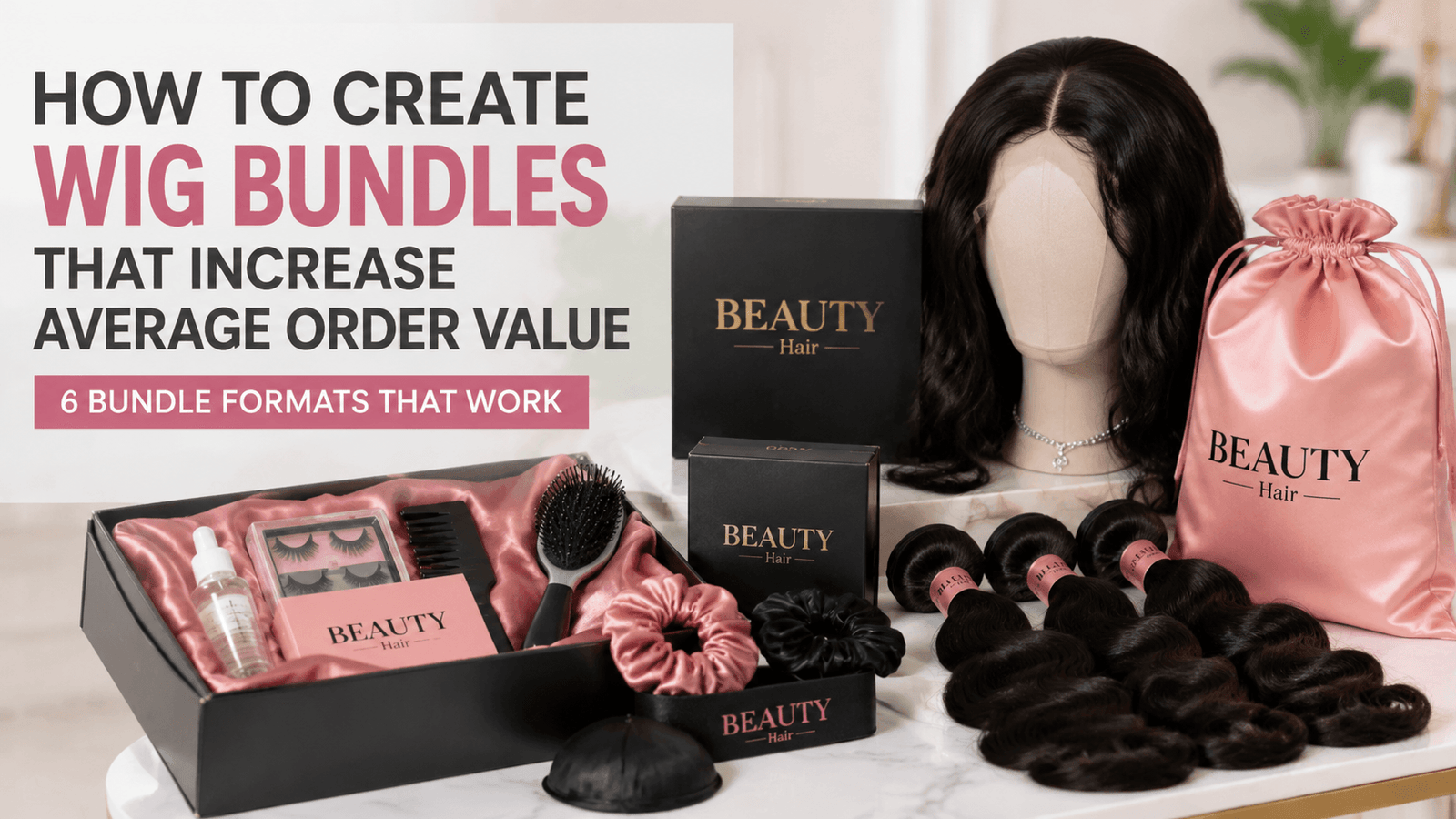
If you want to create wig bundles and sets that increase average order value, the data says it's one of the highest-ROI changes you can make -- product bundling lifts AOV by 20% to 55%, according to 2025 ecommerce data. The six formats that work best for wig businesses are: the Complete Look Bundle, Volume Tier Bundle, Upgrade Bundle, Themed Bundle, Clearance Bundle, and Mystery Box.
Here's the thing most bundle guides won't tell you: the difference between a bundle that boosts your margins and one that eats them isn't the discount percentage. It's how you source the components.
When Sandra launched her online wig store in March 2025, she sold every unit individually. A lace front wig here, a bottle of edge control there. Her average order sat at $85. Six months later, after introducing three curated bundles, her AOV hit $142 -- a 67% jump. Same traffic, same ad spend, same wigs. The only difference: she stopped making customers figure out what to buy together -- she curated complete bundles that answered "what else do I need?" before the customer asked.
Key Takeaways - Product bundling increases wig business AOV by 20-55%, with bundle pages converting at 5-8% versus 2.5-3% for standard product pages - Six wig-specific bundle formats: Complete Look, Volume Tier, Upgrade, Themed/Seasonal, Clearance, and Mystery Box - Price bundles at 10-20% off combined individual total -- enough to feel like a deal without destroying your margin - Sourcing bundle components (wigs + accessories + packaging) from the same China supplier cuts per-unit cost by 15-25% versus buying separately - Bundle buyers return 2.3x more often and have 2.7x higher lifetime value than single-item buyers
Why Wig Bundles Work -- The Data Behind Bundling
Product bundling isn't a marketing gimmick. The numbers on it are unusually consistent across categories and platforms.
Shopify's 2025 analysis of merchants using strategic bundling found an average 55% AOV lift among top performers. Bundle-specific product pages convert at 5-8%, roughly double the 2.5-3% conversion rate of standard product pages. Cart abandonment drops by 32% when customers are offered a curated bundle rather than left to assemble their purchase item by item.
Bundle buyers also stay longer. According to ecommerce bundling research, they return 2.3x more often than single-item buyers and generate 2.7x higher lifetime value. For a wig business, where repeat purchases are the backbone of revenue, that retention difference compounds fast.
Wigs are unusually well-suited to bundling for one specific reason: nobody buys a wig and nothing else. As B2B hair market data confirms, every wig purchase implies companion products -- a cap to wear underneath, glue or adhesive for installation, a comb for maintenance, something to store it in.
The customer was going to buy several of these items anyway. A bundle just captures that spend in one transaction instead of letting it leak to Amazon or the beauty supply store down the street.
What the Numbers Mean for a Real Wig Business
Take a business selling 100 wigs per month at $120 each, with an average of 1.2 items per order. That's $12,000 in monthly revenue.
Add a Complete Look Bundle (wig + cap + glue + comb + storage bag) priced at $155 -- a $180 value. If 30% of customers choose the bundle instead of the solo wig, monthly revenue moves to $13,050. Same customer count. Same traffic. The only thing that changed is how products are grouped.
That's an extra $12,600 per year from one bundle format. Add a second bundle type, and the math compounds.
Image: Bar chart comparing monthly revenue: individual items only ($12,000) vs. with one bundle format ($13,050) vs. with two bundle formats ($14,100+). Alt text: "Bar chart showing monthly wig business revenue growth from $12,000 to $14,100+ after adding product bundles."
6 Wig Bundle Formats That Actually Sell
Not all bundles are created equal. The ones that work share a common thread: they reduce the customer's decision-making load while making them feel like they're getting more for their money.
1. The Complete Look Bundle
This pairs a wig with everything the customer needs to wear and maintain it. It answers the question "what else do I need?" before the customer has to ask it.
A standard Complete Look Bundle includes: - The wig (the anchor product) - Application essentials: lace glue or adhesive, wig tape, or got2b spray - A basic wig care kit: wide-tooth comb, silk or satin storage bag - Maintenance tools: mannequin head or stand, detangling brush - Styling products: heat protectant spray, mousse, edge control, hair serum - Daily accessories: wig grip band, satin bonnet, edge brush
You don't need all of these. Start with 4-5 items that match your specific wig type. A glueless wig bundle skips the adhesive and adds a grip band. A lace front bundle includes adhesive and tweezers for plucking. This is fundamentally a cross-sell strategy -- you're attaching high-margin accessories to a wig purchase the customer was already going to make.
The key is presenting it as a solution, not a collection of random add-ons. "Everything you need to install, style, and protect your wig" reads better than "Wig + 5 items."
2. The Volume Tier Bundle
This is the simplest format to implement: the more wigs a customer buys, the more they save. It works especially well for salon owners and stylists who buy in multiples naturally.
| Quantity | Discount | Who It's For |
|---|---|---|
| Buy 2 wigs | 10% off | Individual buyers upgrading their rotation |
| Buy 3 wigs | 20% off | Salon owners stocking install sizes |
| Buy 5+ wigs | Custom pricing | Wholesale accounts and repeat buyers |
The psychology here is straightforward. Once a customer has decided to buy one wig, the marginal resistance to adding a second is much lower -- especially when there's a visible discount for doing so. The second and third wigs have near-zero additional acquisition cost.
For salon-focused sellers, pre-assemble case packs: 3 wigs in trending lengths (20-inch, 24-inch, 26-inch) in a single texture. Salon owners don't want to click "add to cart" three times. They want one SKU that covers their most common install sizes.
3. The Upgrade Bundle
This format uses price anchoring to move customers to a higher-tier product. Instead of discounting, you're framing the premium option as a logical step up.
Common upgrade paths for wigs: - Standard Remy hair -> Virgin hair ("double the lifespan for $30 more") - 20-inch length -> 24-inch or 26-inch ("for a modest difference, the longer length gives a dramatically different look") - Natural black (#1B) -> Trending color like honey blonde or piano highlights - Regular lace -> HD lace ("nearly invisible hairline for $25 more")
The upgrade bundle works because the price difference feels small relative to the total purchase, but the margin gain for you is meaningful. A customer spending $120 on a standard wig who upgrades to a $155 premium unit just increased your revenue by 29% on that transaction -- with no additional shipping cost, no additional packaging, and no additional pick-and-pack labor.
4. The Themed or Seasonal Bundle
Themes give bundles a reason to exist beyond discounting. They also create urgency and tap into the customer's identity.
A few themes that consistently perform for wig sellers: - "Vacation Ready" Set: Glueless wig + wig grip band + travel-sized dry shampoo + satin storage bag - "Protective Style Starter Kit": Closure wig + wig cap + leave-in conditioner + detangling brush - "Boss Lady" Bundle: Bone straight long wig + silk scarf + premium hair serum - "New Year, New Look" Bundle: Sleek bob + edge control + satin bonnet + mini flat iron
Seasonal bundles follow the demand calendar: summer calls for beach wave units paired with anti-humidity spray; winter favors deep wave textures with heavy moisture products. Holiday gifting season (November-December) is when you should add premium packaging -- tissue paper, branded box, ready-to-wrap presentation.
The best themed bundles make the customer think "this was made for someone like me" rather than "this is a discount on things someone assembled."
Image: Flat-lay product photo of a "Vacation Ready" bundle: glueless wig, travel-sized products, satin storage bag, and wig grip band arranged on a clean surface. Alt text: "Flat lay photo of Vacation Ready wig bundle showing glueless lace front wig, travel dry shampoo, satin storage bag, and velvet wig grip band."
5. The Inventory Clearance Bundle
Every wig business has slow-moving inventory -- the color that didn't trend, the length nobody ordered, the texture that arrived right as demand shifted. Clearance bundles turn that dead stock into cash without slashing prices on your best-sellers.
The formula: pair one slow-moving SKU with one best-selling staple at a combined price that's 15-25% off the individual total. The best-seller carries the perceived value; the slow-mover gets cleared without being heavily discounted on its own.
The critical rule here: never discount your best-selling SKU by itself just to move it faster. You're cannibalizing full-margin sales. Only discount it when it's anchored to a clearance item.
For example: a body wave 22-inch wig (your consistent top seller at $110) paired with a 613 blonde 18-inch unit (slow mover, normally $95). Bundle price: $164. The customer saves $41. You clear a unit that was gathering dust and still make margin on the hero product.
6. The Mystery Box
A "$150 Mystery Wig Box -- value $250+" works on two levels. First, it clears end-of-season colors, discontinued styles, and test textures without listing them at clearance prices. Second, it generates social media content -- customers film themselves unboxing mystery boxes, which gives you free organic reach.
But mystery boxes only work if you get three things right: - Set expectations honestly: "Includes one premium wig (value $120-200) plus 2-3 accessories" is clear. "You might get anything" creates disappointment and returns. - Make every box a genuine deal: The worst outcome for a customer should still feel like they got their money's worth. If "$150 value" means some boxes contain $140 worth, you'll get chargebacks. - Seed some boxes generously: One box in every 30-50 should be an outsized win -- a $300+ wig. Those customers post about it, and the posts bring more mystery box buyers.
Marcus, a Shopify wig seller in Atlanta, started offering mystery boxes in October 2025 to clear discontinued summer textures. He made 40 boxes at $129 each, claiming $200+ value. They sold out in four days. Three customers posted unboxing videos on TikTok -- collectively 180,000 views.
His January 2026 mystery box, restocked with winter clearance inventory, sold 85 units in under a week.
How to Price Your Wig Bundles Without Destroying Your Margins
Bundle pricing is where most wig sellers get it wrong. They either discount too little (and nobody buys the bundle) or too much (and every bundle sale loses money). The fix is to work from your actual costs -- what cost-plus pricing looks like for bundles specifically -- rather than guessing at a discount that sounds good.
The 10-20% Rule
The pricing sweet spot for wig bundles is 10-20% off the combined individual retail price. This range is large enough to make the bundle feel like a genuine deal while preserving healthy margins.
A Complete Look Bundle where the wig retails for $120 and accessories total $60 individually = $180 combined. At 15% off, the bundle price is $153. The customer saves $27 and feels good about it. You capture $33 of accessory revenue you might have lost to another retailer, and your margin on those accessories -- even at a 15% discount -- is still positive.
Always, always show the savings in dollars. "$153 (you save $27)" outperforms "$153 (15% off)" in conversion. Dollars are concrete. Percentages are abstract.
When NOT to Discount
If a bundle is truly curated, themed, and gift-ready -- meaning you've done the work of selecting, packaging, and presenting it as a finished solution -- you can charge full combined price. The value proposition shifts from "save money" to "save time and decision-making effort."
A "Vacation Ready Set" in premium packaging with a clear "everything you need for two weeks of flawless hair" positioning doesn't need a discount. The curation IS the value.
Free Shipping Thresholds
This is the simplest bundle pricing lever and the most overlooked. Set your free shipping threshold just above your most popular bundle price. If your Complete Look Bundle is $153, set free shipping at $175. Customers are now one wig cap or bottle of serum away from free shipping -- and most will add that item rather than pay $8 for shipping.
B2B Wholesale vs. B2C Retail Bundle Pricing
If you sell to both consumers and salon/stylist accounts, you need two bundle pricing structures:
B2C (Consumer): 10-20% off combined retail. Bundle is priced as a deal.
B2B (Wholesale/Salon): Volume tier discounts on case packs. A salon buying 3 wigs per restock gets a 15-20% wholesale discount off your standard wholesale price. The bundle here isn't a curated "set" -- it's a volume discount on multiples of the same product category.
Don't mix these. A consumer "Complete Look Bundle" and a salon "3-Wig Case Pack" serve different buyers with different expectations about pricing. For small business owners just starting out, these bundle ideas adapt to your order volume -- you can begin with 2-3 pre-made options and add complexity as you grow.
Sourcing Bundle Components -- The Part Most Bundle Guides Skip
Here's the reality of wig bundling that generic ecommerce articles never address: the margin on your bundle is determined before you ever list it for sale. It's determined when you order your inventory.
The Separate-Supplier Problem
Most new wig sellers source components from different places. Wigs from one factory in Xuchang. Accessories from random Amazon or AliExpress vendors. Packaging from a local print shop. Every component arrives at a different time, with a different shipping cost, at a different per-unit price. This is a common mistake among buyers who haven't yet established a relationship with a reliable China-based supplier.
This fragmented approach adds 15-25% to your total landed cost per bundle. You're paying separate shipping on three or four different orders. You're not getting volume discounts because each order is small.
You're also spending your own time receiving, checking, and organizing components from multiple sources -- labor that eats into the margin you thought you were protecting.
The Single-Supplier Solution
When you source wigs, accessories, and packaging from the same supplier, three things happen:
-
Combined shipping lowers per-unit freight cost. One shipment instead of four. One customs clearance instead of four. One set of shipping documentation instead of four.
-
Volume pricing applies across categories. A supplier who sees you ordering wigs + 200 wig caps + 200 satin bags + 200 branded boxes treats you as a higher-value account than one who only sees your wig order.
-
Quality consistency across components. When one supplier is responsible for the entire bundle, they can't blame another vendor if something is wrong. Accountability is consolidated.
What Your Wig Supplier Can Also Provide
Many China-based wig manufacturers can supply the full accessory ecosystem for your bundles: - Wig caps (mesh, nylon, breathable) - Wig grip bands and velvet headbands - Satin and silk storage bags - Wide-tooth combs and detangling brushes - Mannequin heads and foldable stands - Edge control, mousse, heat protectant, and hair serum - Lace glue, adhesive tape, and adhesive remover - Custom-branded packaging (boxes, tissue paper, thank-you cards, stickers)
Pre-Kitted Bundles vs. Self-Assembly
You have two options for getting bundle inventory:
Factory Pre-Kitted: Your supplier assembles the complete bundle -- wig, accessories, packaging -- and ships it to you as one ready-to-sell unit. You receive it, maybe add a thank-you card, and ship it to your customer.
Advantages: zero assembly labor on your end, faster fulfillment, fewer picking errors, lower per-unit cost (supplier labor is cheaper than yours).
Self-Assembly: You order components separately from the same supplier, receive them in bulk, and kit them yourself.
Advantages: more control over exact bundle composition, can adjust bundles based on which components are selling, can create multiple bundle variants from the same component inventory.
For most wig businesses doing under 200 orders per month, factory pre-kitting is the better option. The labor savings alone usually cover any small premium the supplier charges for kitting. Once you're above 500 orders per month, the math may shift toward self-assembly, depending on your labor costs.
How to Present and Market Your Bundles
Even the best-curated bundle won't sell if it's presented poorly. The difference between a bundle collecting dust and one that moves is often just presentation.
Product Photography That Sells Bundles
Show every component. Not in a list -- in a photo. The customer needs to see exactly what they're getting.
A flat lay photo with all bundle items arranged neatly on a clean surface works. A lifestyle shot of a model wearing the wig while holding or surrounded by the bundle accessories works even better. For gift-oriented bundles, show the unboxing experience -- tissue paper, branded sticker, the moment of opening.
If your supplier can provide these photos during production, even better. Some China wig factories now offer product photography as part of their OEM/ODM service. Ask during the quoting process.
Bundle Placement on Your Site
A dedicated product page for each bundle is non-negotiable. Bundles listed only as a checkout upsell or hidden in a "deals" section underperform dramatically.
Beyond the dedicated page, place bundle offers in three additional locations: - "Frequently Bought Together" section on individual wig product pages -- shows the bundle version of that specific wig - Cart page upsell: After a customer adds a wig, "Get the Complete Look -- add everything you need and save $27" - Post-purchase email: "Your wig is on the way. Here's what pairs perfectly with it -- 10% off your next order."
Bundle Names That Convert
Name your bundles like products, not like discount offers. "Complete Look Set" tells the customer what it is. "Bundle #3 (15% off)" tells them they're buying a discount.
Good names imply identity or outcome: - "The Ready-to-Wear Set" - "Salon Starter Case Pack" - "The Vacation Vault" - "Protective Style Kit" - "The Boss Lady Edit"
Bad names scream "marketing tactic": - "Bundle A" - "Value Pack #2" - "15% Off Combo Deal"
Common Bundle Mistakes That Kill Your Margins
Mistake 1: Discounting Your Best-Sellers
If a wig sells consistently at full price, don't put it in a discounted bundle. You're trading full-margin sales for discounted ones. Instead, use that best-seller as the anchor for a clearance bundle that moves slow inventory.
Mistake 2: Offering Too Many Options
Decision paralysis is real. A build-your-own bundle with 20 wig choices, 15 accessory choices, and 5 packaging options sounds customer-friendly but kills conversion. Most buyers will click around for a few minutes, get overwhelmed, and leave.
Offer 3-5 pre-made bundles. If you want to offer customization, add one "Build Your Own" option alongside the pre-made ones. The pre-made bundles will account for 80% of your bundle sales.
Mistake 3: Stocking Out on One Component
If your Complete Look Bundle includes a specific wig cap and that cap goes out of stock, the entire bundle is unsellable. Forecast bundle component demand separately from individual SKU demand. Maintain safety stock specifically for bundle components.
Mistake 4: Hiding the Value
Customers need to see, immediately and unambiguously, that the bundle is a better deal than buying items separately. Show individual prices crossed out. Show the total they're saving in dollars. If a customer has to do mental math to figure out whether the bundle is worth it, you've already lost them.
Mistake 5: Bundling Without Testing
Don't order 500 units of pre-packaged bundle inventory before you know it sells. List the bundle on your site first. Even if you can't fulfill it yet, track how many people click "add to cart." If the add-to-cart rate looks healthy, then invest in inventory. If not, adjust the bundle composition or pricing until it does.
Frequently Asked Questions
How much should I discount a wig bundle?
10-20% off the combined individual price preserves healthy margins while giving customers a genuine reason to choose the bundle. If your wig retails for $120 and accessories total $55, a bundle at $150 saves the customer $25 (14% off) while capturing accessory revenue you might otherwise lose.
What should I include in a wig bundle for beginners?
Start with the Complete Look format: the wig itself plus a wig cap, edge control or mousse, a wide-tooth comb, and a satin storage bag. These five items cover the essentials every first-time wig wearer needs. Once you see which add-ons your customers actually buy, expand to include lace glue, grip bands, or a mannequin head.
Do wig bundles actually increase total revenue, not just AOV?
Yes -- and not just because customers spend more per order. Bundle pages convert at roughly double the rate of standard product pages (5-8% vs. 2.5-3%). Bundle buyers return 2.3x more often. So you're getting both a higher per-transaction value AND more repeat transactions from the same customer.
Can I create wig bundles if I source everything from China?
You can, and it's the most cost-efficient way to do it. Request that your supplier pre-kit the bundles -- they source the wigs, accessories, and packaging, assemble everything, and ship you ready-to-sell units. This cuts per-unit cost by 15-25% versus buying components from separate suppliers and kitting them yourself.
What's the best bundle format for selling to salons and stylists?
A Volume Tier case pack: 3 wigs in the most popular lengths (20-inch, 24-inch, 26-inch) in one texture, priced at 15-20% off combined individual wholesale. Salon owners buy in multiples naturally -- they're stocking for install sizes, not personal use. Give them one SKU that covers their standard order and they'll reorder on autopilot.
How do I handle returns on wig bundles?
Set a clear policy: the entire bundle must be returned for a refund. Don't allow partial returns (customer keeps the wig, returns the accessories for a partial refund) -- this opens the door to abuse. Inspect returned wigs carefully; if the lace has been cut or the wig shows signs of wear, it's not resellable. Factor a 3-5% higher return allowance into your bundle pricing to cover this.
Get Your Bundle Components from One Source
Creating wig bundles is one of the highest-ROI changes you can make to your business. It increases average order value, improves conversion rates, and builds customer retention -- all without increasing your ad spend or traffic.
The bundle formats and wig sets covered here work across markets and price points. Start with one format -- the Complete Look Bundle is the easiest to implement -- test it with your customers, and expand from there.
What determines whether your bundles are profitable isn't the discount percentage or the marketing copy. It's how you source. When your wigs, accessories, and packaging come from one supplier, your landed cost per bundle drops. When they come from four different suppliers, your margin leaks out through shipping, handling, and missed volume discounts.
If you're sourcing wigs from China and want to explore bundle-ready inventory -- pre-kitted with accessories and custom packaging, verified through our 4-step inspection process before it ships -- get in touch and we'll help you price it out.
Whether you source from us or build your bundles independently, the formats and pricing rules in this guide will work. The only difference is how much margin you keep.