How to Choose a Reliable Wig Supplier from China: The Complete Checklist for Small Businesses
June 5, 2026 · Marcus Vore
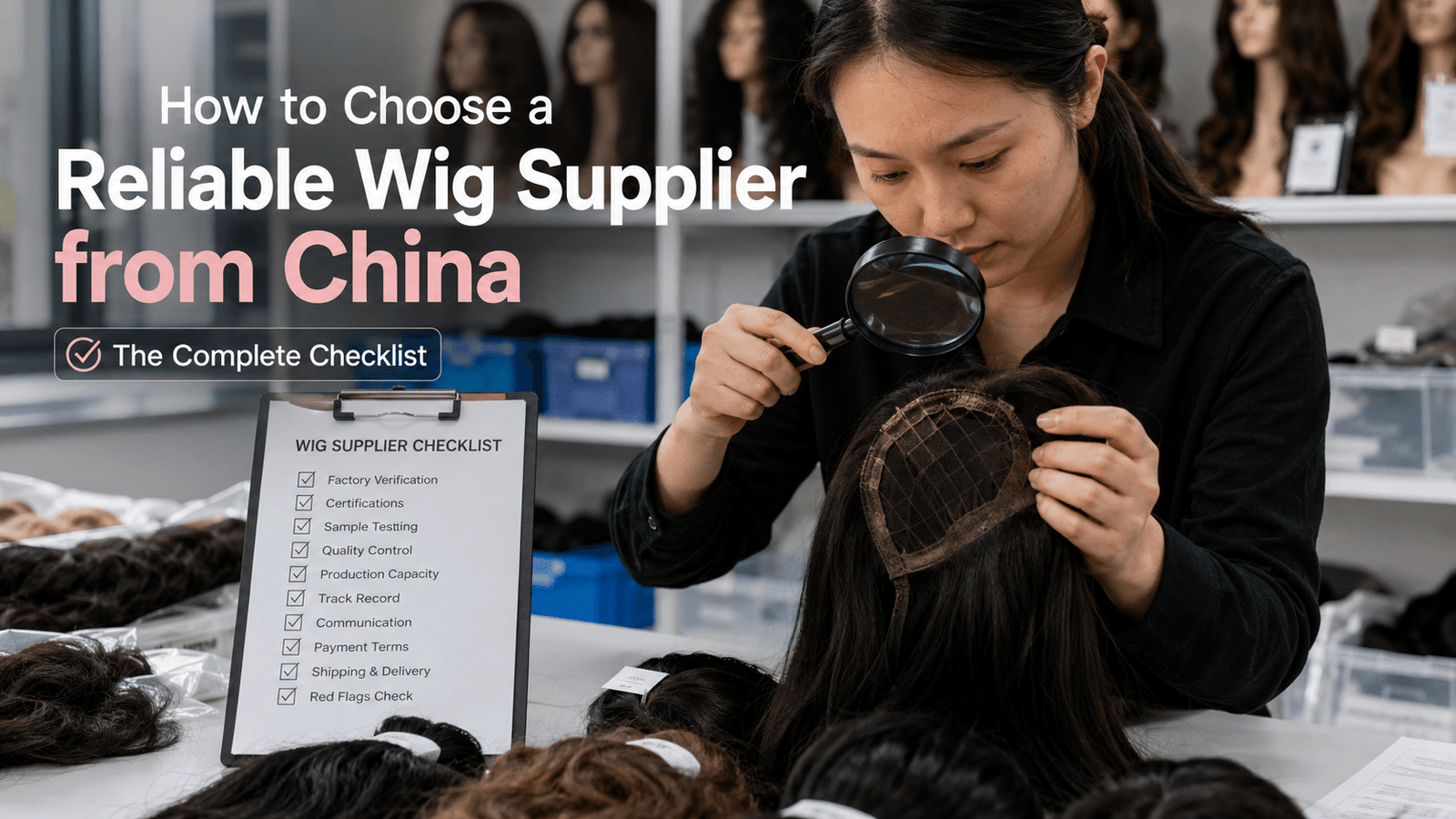
Choosing a reliable wig supplier from China comes down to verifying five things before you send money: the factory is real, the quality matches the claims, the track record is solid, the communication is clear, and your payment is protected. Skip any of these checks and you're gambling with your business.
Here's the thing: nobody starts out expecting to get scammed. Every buyer who ended up with 200 units of shedding, tangled inventory thought they'd done their research. They looked at the photos. They read the reviews. They exchanged a few messages. Everything seemed fine, until the shipment arrived and the quality wasn't what they paid for. The global human hair wig market reached $1.81 billion in 2025 (Fortune Business Insights), and with that volume comes plenty of suppliers — not all of them honest.
Key Takeaways - Verify the factory with a live video tour and check certifications against official databases, photos and PDFs can be faked - Order samples from 2-3 shortlisted suppliers and run the shed test, burn test, and wet test before committing - Check four performance metrics: on-time delivery rate (95%+), reorder rate (25%+), response time (under 4 hours), and review score (4.5+) - Never pay 100% upfront, standard terms are 30% deposit, 70% after pre-shipment inspection approval - Walk away from any supplier who fails two or more of the 10 red flags listed below
When Sarah placed her first wig order in 2024, she found a supplier on Alibaba with beautiful product photos and a 4.8-star rating. She ordered 100 lace front wigs at $38 each. The samples looked great.
The bulk order arrived three weeks late. When her customers washed the wigs, the hair matted within days. Her return rate hit 40%. The supplier stopped responding. Sarah lost $3,800 on the order and another $2,000 in refunded customer payments.
The supplier had sent her "sample-grade" quality and shipped "bulk-grade" — a switch she didn't know to watch for.
This checklist exists so you don't become another version of that story. Use it whether you buy from us or anyone else. If you're new to sourcing from China, start with our guide to finding reliable suppliers for the fundamentals of supplier vetting.
Know Where Real Wig Production Happens
Before you contact a single supplier, understand the geography. China doesn't produce wigs evenly across the country. Different regions specialize in different types of wigs, and knowing which hub matches your product type eliminates half the wrong suppliers immediately.
China's Wig Manufacturing Hubs
| Region | Specialty | Best For |
|---|---|---|
| Xuchang, Henan | Human hair wigs, hand-tied lace fronts, virgin hair | Premium and mid-tier human hair lines |
| Qingdao, Shandong | Machine-made synthetic wigs, fiber extrusion, export compliance | Budget-friendly synthetic, high-volume orders |
| Guangzhou, Guangdong | Trend-responsive styles, fast turnaround, air freight access | Fast-fashion wigs, dropshipping, Western markets |
| Yiwu, Zhejiang | Mass-produced synthetic, heat-resistant fibers, small accessories | Budget basics, seasonal collections |
Xuchang alone produces roughly 60% of the world's wigs, with over 4,000 enterprises employing around 300,000 people. According to industry data from China Hair Expo, the city's annual wig-related import-export volume reached 194 billion RMB (about $27 billion) in 2024. If you're buying human hair wigs, there's a strong chance your supplier — or their raw materials — pass through Xuchang.
Manufacturer vs. Trading Company
Not every "factory" is a factory. Many suppliers on B2B platforms are trading companies that buy from factories and resell to you.
That's not automatically bad — good trading companies add value through QC, consolidation, and communication. But it means you're paying a markup, and quality control may be inconsistent.
When you first contact a supplier, ask: "Which production processes do you handle in-house, and which do you outsource?" A real manufacturer can name specific processes, ventilation, knotting, cap sewing, dyeing, finishing. A trading company will give you a vague answer or dodge the question.
Quick test: Ask for a photo of their production floor with a handwritten note showing today's date. A real factory can do this in 10 minutes. A trading company will make excuses.
Phase 1: Verify the Factory Is Real
If the factory doesn't exist or isn't what they claim, nothing else matters. This is your foundation.
The Live Video Tour Test
A factory that passes this test will show you working production lines, raw materials in storage, QC stations with staff, and finished goods being packaged. Not a conference room. Not a showroom. The actual floor.
Here's exactly how to do it:
- Schedule a video call via WhatsApp or WeChat
- Ask them to start at the factory entrance and walk through the production floor
- Request they show you a specific station on the spot, "show me the ventilation station" or "walk over to where the lace is being hand-tied"
- Watch for: workers actively producing (not standing around), raw hair materials visible, QC checkpoints with documentation, and packaging areas with shipping labels
A pre-recorded video can't respond to your specific requests. A live tour can. If a supplier refuses a live tour, "factory policy," "confidential processes," "our marketing team handles that", they either don't have a factory or don't want you to see their real operation.
Certifications: Check Them, Don't Just Accept Them
Suppliers know buyers look for certifications. Scammers know this too. Here are the ones that matter for wig sourcing and how to verify them:
| Certification | What It Covers | How to Verify |
|---|---|---|
| ISO 9001 | Quality management systems in place | Ask for certificate number, check at certifying body's database |
| BSCI / SMETA / Sedex | Ethical labor practices, working conditions | Request the full audit report, not just the certificate |
| OEKO-TEX Standard 100 | Materials free from harmful chemicals | Verify at oeko-tex.com with certificate number |
| GB/T 41637-2022 | China's national standard for hair products | Ask for the test report from an accredited lab |
Red flag: a supplier sends you a PDF of a certification but the certificate is issued to a different company name, a different address, or has expired. Always verify the certificate applies to the specific factory you're evaluating.
Factory Metrics Benchmarks
For small businesses ordering 10-100 units at a time, look for:
- 5+ years in business, less than two years carries higher risk
- 1,000+ m² facility, smaller is fine for boutique production, but verify it's real production space, not a showroom
- 50+ employees, signals operational stability and capacity
- Business license verifiable on China's National Enterprise Credit Information Publicity System
Phase 2: Check Their Track Record
A factory can be real and still be unreliable. Performance data tells you whether they deliver what they promise, when they promise it.
The Four Performance Metrics
| Metric | Minimum Acceptable | Excellent | Where to Find It |
|---|---|---|---|
| On-time delivery rate | 95%+ | 98%+ | Supplier's Alibaba/Made-in-China profile |
| Buyer reorder rate | 25%+ | 35%+ | Platform transaction data |
| Response time | Under 4 hours | Under 2 hours | Time your own inquiry |
| Review score | 4.5/5.0+ | 4.7/5.0+ | Platform reviews |
An on-time delivery rate below 95% means roughly one in twenty orders arrives late. For a small business operating on thin inventory margins, that's a stockout waiting to happen. A reorder rate below 25% means most buyers try them once and don't come back. That's the data telling you what you need to know.
How to Read Reviews Like a Detective
Don't stop at the star rating. Do this instead:
- Read the 2-4 star reviews first. Five-star reviews often say "good quality, fast shipping", which tells you nothing. The critical reviews reveal patterns. Are multiple buyers mentioning shedding after washing? Late deliveries? Quality not matching samples? One complaint is an anomaly. Three complaints about the same issue is a pattern.
- Look at the review dates. A supplier with great reviews two years ago but declining scores over the past six months may have changed management, cut costs, or outgrown their QC capability.
- Check if the supplier responds to negative reviews, and how. A professional response that acknowledges the issue and describes the fix is a green flag. Defensive, dismissive, or no response at all is a red flag.
Red Flags in the Data
- Annual online transaction volume under $100,000, may indicate a new or unstable operation
- Reorder rate under 15%, buyers vote with their wallets
- Review score under 4.0 or trending downward
- Gaps in transaction history, a supplier that was active, went quiet for months, then reappeared may have rebranded to escape bad reviews
Phase 3: Test Quality Before You Commit
This is where you catch 90% of potential quality problems, before they become your customers' problems.
How to Order Samples the Right Way
Most buyers make the same mistake: they order one sample from one supplier, it looks fine, and they place a bulk order. That's like marrying someone after the first date.
Order samples from 2-3 shortlisted suppliers simultaneously. Expect to pay $10-50 per sample for human hair wigs. Shipping via express courier takes 3-7 days. Total sample investment: roughly $100-200 with shipping. Compare that to losing $3,000+ on a bad bulk order and the math is clear.
Important: Tell each supplier you're comparing samples from multiple vendors. Suppliers who know they're being compared tend to send their actual production quality, not a special "sample-only" batch.
The 8-Point Sample Inspection
| Test | What It Reveals | Method | Passing Standard |
|---|---|---|---|
| Burn test | Human hair vs. synthetic vs. blend | Burn 5-10 strands: human hair smells like burning protein, turns to ash; synthetic melts into a hard bead, smells like plastic | All strands ash, no melting |
| Shed test | Knot quality, construction integrity | Brush through hair 10 times with wide-tooth comb, count loose strands | 0-8 loose hairs acceptable; 15+ = reject |
| Wet test | Processing level, silicone coating | Wet a section completely, observe texture, air dry | Hair feels smooth wet; dries back to original texture; no gummy feel |
| Cuticle check | Remy vs. non-Remy | Run fingers root-to-tip (smooth) then tip-to-root (slight resistance). Water slide test: Remy sinks uniformly | Smooth root-to-tip; slight grab tip-to-root; uniform water slide |
| Color accuracy | Match to specification | Check under natural daylight, not indoor lighting | Matches reference within one shade tolerance |
| Lace inspection | Lace quality and realism | Hold to light, stretch gently, inspect knot density | Thin and transparent against skin; knots small and tight; edges lay flat |
| Cap comfort | Fit and breathability | Try on or measure against size chart; check adjustable straps | Comfortable for intended wear duration; straps functional |
| Wash durability | Post-wash behavior | Wash once with mild shampoo, air dry, comb through | No significant tangling, texture change, or color bleeding |
Mike, an e-commerce seller in Texas, ordered samples from three Xuchang suppliers for his Shopify wig store. Supplier A's sample shed 12 hairs on the brush test. Supplier B's shed 4 hairs. Supplier C's shed 3. He ordered bulk from Supplier C at $42 per unit, $7 more than Supplier A's quote. Six months later, his return rate is under 5% and his review score is 4.8. He's making more profit per unit than if he'd gone with the cheaper supplier and eaten the returns.
The Golden Sample Rule
Once you approve a sample, it becomes your contract reference. Both you and the supplier keep one. Every future order must match this physical sample. If bulk arrives and doesn't match, you have an objective standard to dispute with, not just "quality seems different" but "this unit weighs 145g versus the golden sample's 170g."
Take dated photos of the golden sample from multiple angles. Note the weight, density, lace color, and any distinguishing characteristics. Store it in a sealed bag away from light and humidity.
Phase 4: Start Small Before You Scale
You've verified the factory. You've tested samples. Now validate with real customers before committing serious money.
The Trial Order
Place a small order, 10-50 units, mixed SKUs (different lengths, densities, or colors). This tests:
- Whether bulk production quality matches sample quality
- Whether the supplier can handle SKU variation without mixing up specs
- Whether packaging and labeling are accurate
- Whether delivery arrives on time and complete
- What your actual customers think (not just you)
Collect customer feedback systematically on the trial batch. If return rates are below 8% and feedback is positive, you have data to justify scaling. If not, you've limited your exposure to a small order rather than a container load.
Payment Terms That Protect You
Standard B2B terms for first orders: 30% deposit to start production, 70% balance after you approve pre-shipment inspection photos and videos. Never pay 100% upfront on a first order with a new supplier — you lose all leverage the moment the money clears. Understanding your total landed cost including duties helps you budget accurately before committing.
For payment protection, use: - Alibaba Trade Assurance (if ordering through the platform) — holds payment until you confirm goods match the order - Escrow services for off-platform transactions - PayPal Goods & Services for smaller sample orders
Avoid Western Union, MoneyGram, or direct bank wire for 100% upfront payment to an unverified supplier. These offer zero recourse if something goes wrong. For a deeper breakdown of shipping and payment logistics, see our complete guide to shipping from China.
Split Your First Large Order
When you're ready to scale beyond 100 units, consider splitting your order across two qualifying suppliers. This does two things: it reduces your risk if one supplier has quality issues, and it gives you real-world performance data to compare. After 2-3 months of customer feedback, you'll know which supplier deserves your full volume.
Phase 5: 10 Red Flags That Mean Walk Away
Some warning signs are unambiguous. If you see two or more of these, close the conversation and move to your next candidate.
-
Refuses a live video factory tour. Every legitimate factory has a smartphone. If they won't show you their production floor in real time, they're hiding something.
-
Prices 40%+ below market average. Virgin human hair wigs have a floor price determined by raw material and labor costs. If suppliers A, B, and C quote $40-55 for the same spec and supplier D quotes $25, supplier D is not giving you a deal. They're giving you synthetic blends or non-Remy hair labeled as virgin.
-
Can't provide a verifiable business license. A business license with a real address that matches their claimed location is table stakes. If they can't produce one, or the one they produce is for a different company at a different address, walk.
-
Won't share QC documentation or batch traceability records. A factory with real quality control has paperwork, incoming material inspection logs, in-process check sheets, final QC reports with lot codes. "We check everything, trust us" is not a QC system.
-
Response time consistently exceeds 24 hours. If they're slow to respond when you're a prospect trying to give them money, imagine how responsive they'll be after they have your payment and there's a problem.
-
Pressure tactics. "Order today or the price goes up tomorrow." "Limited stock, must decide now." "Another buyer is interested in this batch." These are sales tactics, not supplier communication. Legitimate manufacturers don't operate on high-pressure deadlines. Their production lines run regardless of whether you order today or next week.
-
Sample-to-bulk quality drift mentioned in reviews. If multiple reviews say "samples were great but bulk order quality was different," this is a pattern, not an accident. Some suppliers deliberately send higher-quality samples than what they produce in bulk.
-
No third-party certifications or expired certifications. For wig products, OEKO-TEX and ISO 9001 are the baseline. For EU-bound products, REACH compliance matters. If they can't produce current, verifiable certificates, their materials and processes haven't been independently audited.
-
Demands 100% upfront payment for a first order. This transfers all risk to you. Even if the supplier is legitimate, you have no leverage if quality or timing issues arise.
-
Vague about hair origin and sourcing. "It's human hair" isn't an answer. A legitimate supplier can tell you: country of origin, collection method, and whether donors were compensated. If they can't explain where their hair comes from, they either don't know or don't want you to know.
After You Choose: Building a Long-Term Supplier Relationship
Finding a reliable supplier is step one. Keeping them reliable over multiple orders requires ongoing attention.
When Marcus found a supplier he trusted after testing three candidates, his first instinct was relief — finally, he could stop worrying about quality and focus on sales.
Six months later, his fourth order arrived with noticeably thinner lace than the golden sample. The supplier had changed their lace supplier to cut costs and didn't mention it. Marcus caught it because he still had his golden sample from order one and measured both side by side. The supplier replaced the batch — but only because Marcus had documented proof of the original spec.
Lock In Your Specs
Create a version-controlled spec sheet for each SKU. Include: lace type, density percentage, cap size, hair length, color code, texture, packaging requirements, and the golden sample reference photo with date. Send this spec sheet with every purchase order. If anything changes, the supplier must notify you and get written approval.
Maintain Quality Over Time
Schedule a check-in before every production run. Ask for in-process photos at key stages. Don't wait until the pre-shipment inspection to discover that something drifted, by then, the batch is already made and you're negotiating fixes instead of preventing problems.
When to Re-Evaluate
Even good suppliers can decline. Watch for: delivery delays becoming more frequent, quality slipping on repeat orders, communication getting slower, or the supplier becoming evasive about changes to materials or processes. These are early signals that it's time to qualify a backup supplier, before you're forced to by a failed order.
Frequently Asked Questions
How do I know if a wig supplier on Alibaba is legitimate?
A legitimate Alibaba supplier has: Verified or Assessed Supplier status (verified by a third-party inspection company), Trade Assurance capability, a transaction history showing consistent orders over time, and a reorder rate above 25%. Beyond platform data, request a live video tour and test with a sample order before committing. Alibaba badges are a starting filter, not proof of quality.
What is a reasonable MOQ for a small wig business?
For stock human hair wigs, many Xuchang-based manufacturers offer MOQs as low as 1-10 pieces for first orders. Custom colors, lengths, or private label typically require 30-100 pieces. Expect to pay 10-30% more per unit at low MOQs, this reflects the factory's setup costs spread across fewer units. Start with stock items to test the market before investing in custom production.
How much should I budget for samples?
Budget $150-400 for a proper sampling round. Each sample costs $10-50 for human hair wigs, plus $30-50 for express shipping per supplier. Order from 2-3 suppliers and you'll spend roughly $200-400 total, including shipping. Compare that to the cost of a bad bulk order and it's the best money you'll spend in your sourcing process.
Can I visit a wig factory in China in person?
Yes. Xuchang, Qingdao, and Guangzhou are all accessible. Most manufacturers welcome visits, it signals you're a serious buyer. Give them 1-2 weeks' notice. If you can't visit personally, hire a third-party inspection service (SGS, Bureau Veritas, Intertek) to do an on-site audit for roughly $300-500. The audit report will confirm whether the factory matches what the supplier claims.
What's the safest way to pay a new wig supplier?
For first orders under $5,000: use Alibaba Trade Assurance if buying through the platform, or PayPal Goods & Services for samples. For larger orders: 30% deposit via bank wire (T/T), 70% balance after you approve pre-shipment inspection photos. Never pay 100% upfront to a supplier you haven't completed at least two successful orders with.
How do I verify the hair is really virgin human hair?
Ask for a burn test video from the supplier before ordering samples. When you receive samples, do your own burn test: real human hair burns to ash and smells like burning protein. Synthetic melts into a hard bead and smells like plastic.
Then do the wet test. Heavily processed hair feels gummy when wet and doesn't return to its original texture after drying. Virgin hair should feel smooth wet and return to its natural state when dry.
Your Sourcing, Protected
Finding a reliable wig supplier from China isn't about luck. It's about process. Verify the factory is real. Check the track record with data, not gut feeling. Test samples rigorously. Start with a small order. And know the red flags that mean it's time to walk.
The cheapest supplier is rarely the most profitable. A supplier charging $5-8 more per unit but delivering consistent quality, on time, with clear communication will save you far more in avoided returns, customer complaints, and inventory write-offs than you'll ever save chasing the lowest quote.
Need a supplier who passes every check on this list? Learn about our 4-step verification process — factory audits, sample approval, production QC, and pre-shipment inspection with photos and videos sent to you before every shipment.
Contact us for a personalized quote with product specs within 24 hours. Or reach us directly:
- WhatsApp: +86 17347350405 (fastest response)
- Email: hello@voretrade.com
Whether you source from us or use this checklist to find your own supplier, the process is what protects your business. Don't skip steps.