Faux Hair and False Hairpieces: A Practical Guide to Synthetic Hair Additions, Toupees, and Hairpieces
August 10, 2026 · Marcus Vore
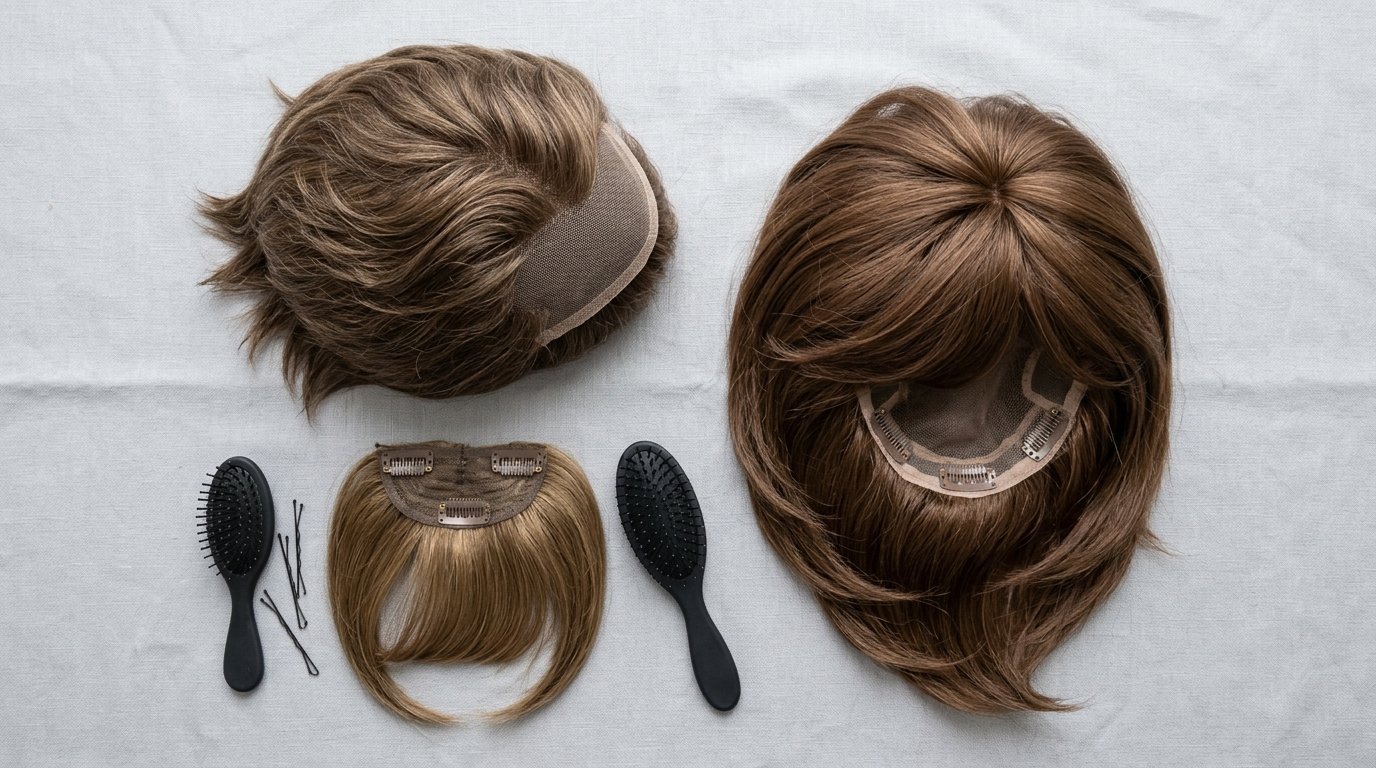
The language around hair additions has always been slightly inconsistent. Walk into a beauty supply store and you will find the same basic product category labeled "hairpieces," "hair additions," "false hair," or "faux hair" depending on which retailer or brand is doing the labeling. Online, the variation is even wider. Understanding what these terms actually mean -- and more importantly, what the products they describe actually do -- is the first step toward buying something that works for your specific situation.
This guide cuts through the terminology and covers the practical landscape: what faux hair and false hair actually refer to in the current market, how synthetic hair pieces differ from their human hair counterparts, what a synthetic toupee actually is and when it makes sense, and what separates convincing false hair from the kind that draws attention for all the wrong reasons.
What "Faux Hair" and "False Hair" Actually Mean
Both terms -- faux hair and false hair -- simply mean hair that is not naturally growing from the wearer's head. The "false" or "faux" designation is about the origin of the hair, not about whether it looks fake. A well-made faux hair addition can look completely natural; the term describes what it is, not how convincing it is.
In practice, faux hair additions divide into two primary material categories:
- Synthetic fiber: Machine-made fiber designed to resemble human hair. Ranges enormously in quality from obviously plastic-looking cheap fiber to high-quality heat-resistant fiber that can be mistaken for real hair at casual glance.
- Human hair: Real hair sourced from human donors, processed and constructed into hairpieces. More expensive, more natural-looking and feeling, and more versatile for styling. Not technically "faux" in the material sense, but still "false hair" in the sense of not growing from the wearer's head.
This guide focuses primarily on synthetic options, which represent the majority of the faux hair market by volume and the most common point of confusion for buyers.
Types of Synthetic Hair Pieces
Clip-In Synthetic Hair Pieces
The most common and accessible form of false hairpiece synthetic hair. Clip-in additions attach to the natural hair using pressure-sensitive snap clips that open, press against a section of hair, and close to grip. They are available as single wide wefts (covering a large section of the head in one piece), as multiple smaller wefts sold together, and as individual strand-width additions for specific spot coverage.
Clip-in synthetic hairpieces serve several practical purposes:
- Length extension: Adding several inches of length to shorter natural hair instantly, without any chemical treatment
- Volume addition: Adding fullness to thinning or naturally fine hair that lacks the body desired for a specific style
- Highlight or color accent: Adding a streak or section of a different color to the natural hair without dyeing
- Spot coverage: Covering specific areas of visible thinning that are not extensive enough to require a full wig or topper
The limitation of clip-in synthetic hair pieces: they must be removed before washing, before sleeping, and before any activity where the clips could be dislodged. They provide coverage only in the areas where clips are placed, rather than consistent coverage across the entire head.
Synthetic Hair Toppers
A hair topper sits on the top of the head, covering the crown and part line area where thinning is most visible. Synthetic toppers attach with clips that press onto the natural hair at the perimeter of the topper base, and the hair of the topper falls over and blends with the natural hair at the sides and back. Synthetic hair toppers are significantly less expensive than their human hair counterparts, but require more careful product selection because the synthetic fiber needs to match the natural hair's texture and movement convincingly for the blend to work.
Synthetic Toupees
The word "toupee" carries significant cultural baggage -- decades of jokes about obvious hairpieces that fooled no one have made it a somewhat loaded term. But a synthetic toupee is simply a specific type of false hairpiece designed to cover partial hair loss at the crown or top of the head, typically for men, where the surrounding natural hair is still present at the sides and back.
Modern synthetic toupees are meaningfully different from the obvious hairpieces of the past. Improvements in synthetic fiber quality, base construction, and attachment methods have produced synthetic toupees that work acceptably well in everyday settings -- particularly for men whose hair loss is moderate and whose natural hair still provides a surrounding frame for the toupee to blend into.
A synthetic toupee typically attaches via:
- Tape: Double-sided tape strips applied to the base of the toupee and pressed onto the scalp or existing hair. Provides secure hold for most daily activities. Needs to be replaced weekly or every few weeks depending on the tape type.
- Clips: Small pressure clips attached to the perimeter of the toupee base that grip onto existing hair at the sides. Less secure than tape but easier to remove and reattach without a professional.
- Adhesive (glue): Liquid adhesive applied to the scalp that creates a waterproof, activity-proof bond. The most secure attachment method, typically used for continuous-wear systems rather than daily-removal toupees.
Synthetic Hair Falls and Extensions
False hair that adds significant length and volume to existing long hair rather than providing scalp coverage. Hair falls are large, loose pieces that clip or tie into long natural hair to create the impression of dramatically more hair. They are popular in theatrical, festival, and alternative fashion contexts where the scale of the hair addition is part of the aesthetic rather than something to conceal.
What Makes Synthetic Hair Pieces Look Natural vs. Obvious
Not all synthetic hair pieces look equally convincing. The factors that most determine whether faux hair reads as natural or artificial:
Fiber Quality and Sheen
This is the single biggest differentiator between synthetic hair additions that pass casual scrutiny and those that do not. Low-quality synthetic fiber has a uniform, plastic-like sheen that catches light in an obviously unnatural way. Quality synthetic fiber -- the kind used in premium wig and hairpiece construction -- has more varied, diffuse light reflection that mimics the way natural hair catches light from different angles. The difference is immediately visible when comparing products side by side in person.
Color Matching
A synthetic hairpiece in a perfectly matched color that fits seamlessly with the surrounding natural hair will always look better than a higher-quality piece in the wrong shade. Color matching is arguably more important than any other single factor for blended additions (toppers, clip-ins, toupees) where the false hair must merge visually with real hair. Most synthetic hair pieces are available in dozens of color options including multi-tonal shades and highlights, but matching precisely still requires careful comparison of the piece to the actual hair in natural light rather than store or screen lighting.
Base Construction
For toppers and toupees where part of the base will be visible through the hair, the construction material of the base significantly affects realism. Thin, skin-tone base materials (polyurethane or thin film) mimic the appearance of a natural scalp much better than fabric or mesh bases. Monofilament bases -- where each hair is individually tied through a skin-like transparent material -- produce the most natural-looking scalp appearance because the hairs can be parted in any direction, just like natural growing hair.
Frequently Asked Questions
How long does synthetic faux hair last before it needs to be replaced?
The lifespan of synthetic hair pieces varies considerably based on the quality of the fiber, how frequently the piece is worn, how it is cared for, and what activities it is worn during. As a practical guide: a quality synthetic clip-in hairpiece worn several times a week and cared for correctly (gentle detangling with a loop brush, occasional washing with synthetic-specific shampoo, proper storage on a wig head) typically lasts 6-12 months before the fiber quality visibly degrades. A synthetic toupee worn daily sees more wear and washing and typically needs replacement every 3-6 months, though higher-quality constructions can extend this. The fiber degradation that signals replacement time is usually frizzing that does not resolve with conditioning, loss of the original style shape, and a dull, matte texture that replaces the original healthy sheen. Synthetic faux hair cannot be meaningfully restored once the fiber has significantly degraded -- unlike human hair, synthetic fiber cannot be deep-conditioned back to health, and most visible degradation is irreversible once it has occurred.
Can a synthetic toupee or false hairpiece look natural enough for daily professional use?
The honest answer is: it depends on the quality of the piece, the quality of the attachment, the color match, and the skill of whoever manages the installation. A high-quality synthetic toupee with a monofilament or thin-skin base, matched precisely to the wearer's natural hair color and texture, attached with good-quality tape or adhesive by someone experienced with application, can look convincing enough for professional settings where the wearer's colleagues are not specifically looking for a hairpiece. The situations where synthetic toupees are most likely to be detected in professional settings: from directly above (where the part area and base perimeter may be visible), in very windy outdoor conditions (where the piece can lift or shift slightly), and after the piece has been worn for a full day without any maintenance (when the fiber begins to show the effects of movement and the attachment may have loosened slightly). Men who require professional-level realism for extended daily wear typically find that the investment in a human hair-constructed piece with professional fitting and periodic professional maintenance is worthwhile despite the higher cost, because human hair pieces perform more naturally across all the conditions that synthetic pieces struggle with. For occasional professional wear where the piece is worn for defined periods rather than all day, quality synthetic false hair often performs adequately.
If you are a beauty supply retailer, hair salon, or hairpiece specialist looking to source synthetic hair pieces, synthetic toupees, and false hairpieces at wholesale pricing, contact our sourcing team. We supply synthetic and human hair additions for retail businesses at competitive wholesale pricing.
WhatsApp: +86 17347350405
Email: hello@voretrade.com