Deep Conditioner for Wigs: How to Restore Human Hair Wigs and When Deep Conditioning Actually Makes a Difference
August 13, 2026 · Marcus Vore
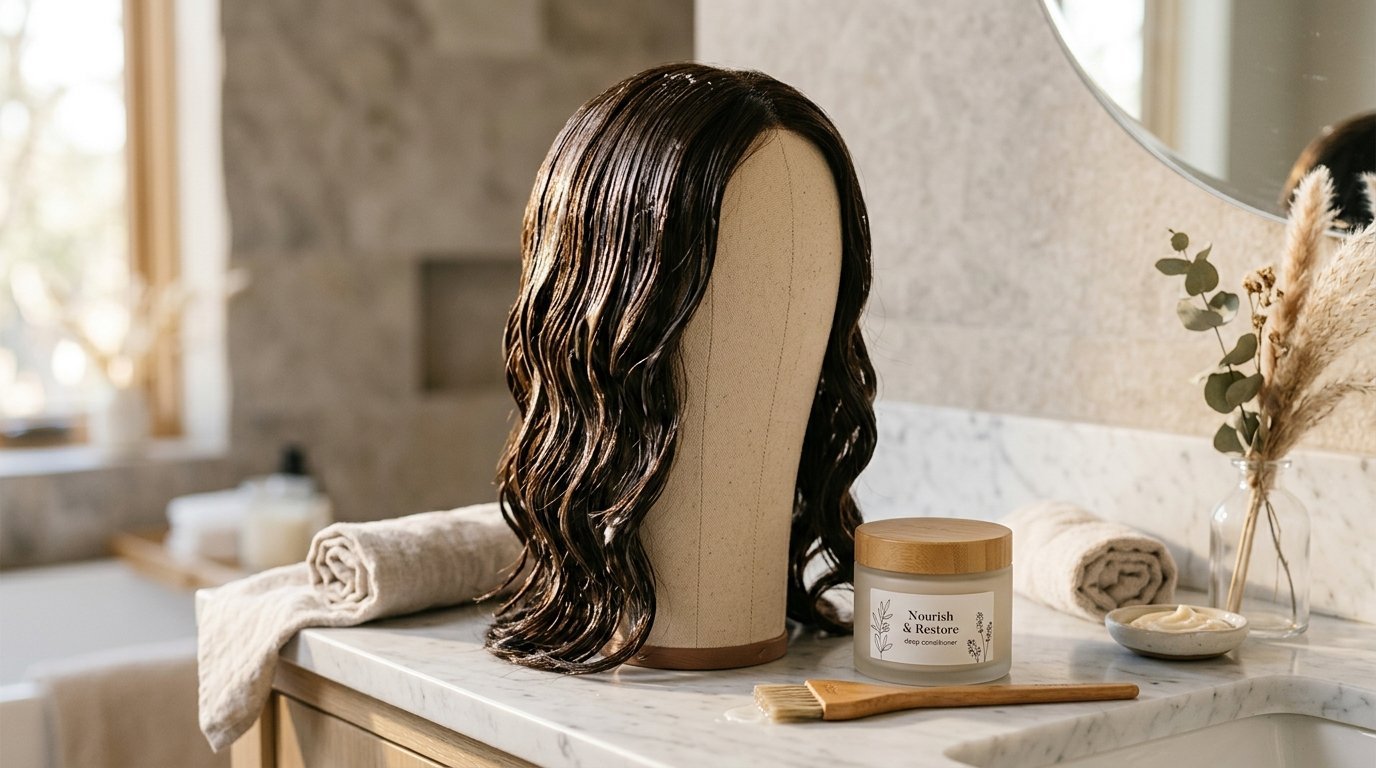
There is a noticeable difference between a human hair wig that has been properly deep conditioned and one that has been maintained only with leave-in spray and regular washing. The deep conditioned wig moves differently -- the hair is softer, more elastic, less prone to snagging during detangling, and has a richer, less dull appearance. For wigs that have been worn regularly for several months, this difference is not subtle.
A deep conditioner for wigs is not the same as leave-in conditioner, and it is not interchangeable with rinse-out conditioner used during washing. It is a dedicated intensive treatment designed to penetrate the hair shaft more deeply, remain in contact with the hair long enough to restore moisture and protein structure, and address the cumulative dryness that develops in wig hair over time. This guide covers when and why to use it, what ingredients actually work in a deep conditioner for human hair wigs, and the correct process for maximum benefit.
Why Human Hair Wigs Need Deep Conditioning More Than Natural Hair
The case for deep conditioning a human hair wig is more urgent than the case for deep conditioning your own natural hair, for a structural reason: natural hair has a continuous supply of scalp-derived oils that provide baseline moisture and surface protection between washes. A wig has none of this. Every wash cycle removes moisture that the wig cannot replenish through biological processes. Every heat styling session depletes moisture further. The cumulative effect over months of regular wear is a wig that becomes progressively drier, more porous (as the cuticle becomes increasingly raised and rough), and more difficult to manage.
A deep conditioning treatment reverses some of this progression. It cannot permanently restore a wig to its original factory condition -- the hair's processing history sets a ceiling on what restoration is possible -- but it can meaningfully improve softness, reduce tangling, restore some elasticity, and improve the hair's ability to hold a style after styling. Many experienced wig wearers describe the post-deep-conditioning wig as feeling "like new" relative to the pre-treatment state, even on wigs they have worn for over a year.
When to Deep Condition a Human Hair Wig
Deep conditioning is most beneficial in these situations:
- Monthly maintenance: For wigs in regular rotation, a monthly deep conditioning treatment prevents the accumulation of dryness before it reaches a point of noticeable degradation. Prevention is more effective than correction.
- After excessive heat styling: A period of frequent heat tool use -- straightening or curling the wig repeatedly over a week or two -- depletes moisture faster than regular wear. Deep conditioning after a heavy heat styling period restores what was lost.
- After color treatment: If a human hair wig has been toned, colored, or highlighted, the chemical processing opens the cuticle and removes moisture. Deep conditioning immediately after and then again a week later is standard post-color care for wig hair.
- When the wig develops increased tangling: Increased tangling that is not resolved by regular detangling and leave-in conditioning is typically a sign of elevated porosity -- the cuticle is raised and rough, causing strands to catch on each other. Deep conditioning smooths the cuticle temporarily and reduces this friction.
- When the hair looks dull or feels rough: Visual dullness and a rough hand feel are early-to-mid indicators of moisture deficit. At this stage, deep conditioning is very effective; waiting until the hair feels brittle or breaks easily makes restoration more difficult.
What to Look for in a Deep Conditioner for Human Hair Wigs
The best deep conditioner for human hair wigs should contain a combination of ingredient categories that work together:
Penetrating Oils
Oils that are small enough in molecular weight to penetrate the hair shaft rather than just coat the surface provide internal moisture and protein support. The most effective penetrating oils for wig hair:
- Coconut oil: One of the best-researched penetrating oils for human hair. Reduces protein loss during washing, temporarily fills gaps in damaged cuticle from inside the hair shaft, and provides a baseline of internal moisture. Works particularly well on straight and wavy wig textures.
- Avocado oil: Rich in oleic acid and penetrates well into the hair shaft, particularly for drier or coarser hair textures. Less likely than coconut oil to cause protein sensitivity in hair that reacts poorly to protein overload.
- Olive oil: A well-established conditioning oil with good penetration for medium to coarse hair. Best for wig textures on the drier, more porous end of the spectrum.
Humectants
Ingredients that draw water into the hair shaft and hold it there are essential in a deep conditioner for providing lasting moisture rather than just surface coating:
- Glycerin, panthenol (Pro-Vitamin B5), aloe vera, and honey are all effective humectants that appear frequently in well-formulated deep conditioners.
Proteins (Used Selectively)
Hydrolyzed proteins temporarily strengthen damaged hair by filling gaps in the cuticle structure. For wig hair that has been processed or heat-styled extensively, protein-containing deep conditioners provide structural reinforcement. However: protein balance matters. Hair that receives too much protein becomes stiff and brittle rather than soft and elastic. For wigs that are already feeling stiff or that have had several protein treatments recently, choose a moisture-only deep conditioner rather than one with added protein, and return to protein treatments only after the hair's flexibility has been restored.
Emollients and Film-Formers
Ingredients like shea butter, cetyl alcohol, and silicones provide surface smoothing that improves the immediate feel and appearance after deep conditioning, reduces friction between strands, and locks in the moisture delivered by the humectants and penetrating oils.
Recommended Deep Conditioners for Human Hair Wigs
- Olaplex No. 3 Hair Perfector: A bond-building treatment (not a traditional conditioner, but functions as a pre-wash deep treatment) that repairs the disulfide bonds broken by chemical processing and heat. Particularly valuable for wigs made from processed or colored hair. Apply before washing, leave for 10-30 minutes, then proceed with normal washing and conditioning.
- SheaMoisture Manuka Honey and Mafura Oil Intensive Hydration Masque: A rich, moisture-forward deep conditioner that works well on textured human hair wigs. Strong on humectants and emollients, with a penetrating oil blend. Best for dryer, more porous wig textures.
- Briogeo Don't Despair, Repair! Deep Conditioning Mask: A balanced moisture-and-protein formula that works across a wide range of hair types. One of the most consistently recommended deep conditioners in the wig care community for its ability to improve both softness and strength without tipping into protein overload.
- Redken Extreme Strength Builder Plus Mask: A salon-grade protein-repair deep conditioner suited for wigs that have experienced significant damage from heat or chemical processes. Use sparingly -- this is a higher-protein formula and should be alternated with moisture-only treatments.
- Cantu Shea Butter Deep Treatment Masque: An accessible, affordable option that delivers good moisture restoration for price. Particularly well-suited for wavy and curly human hair wigs.
How to Deep Condition a Human Hair Wig: Step by Step
- Wash the wig first: Deep conditioning works best on clean hair. Shampoo with a gentle or sulfate-free shampoo, rinse thoroughly, and gently blot excess water with a towel. The wig should be damp but not dripping.
- Apply the deep conditioner generously: Unlike rinse-out conditioner used during regular washing, deep conditioning requires thorough coverage. Apply the treatment from mid-shaft to ends, distributing evenly with fingers or a wide-tooth comb. Do not apply heavily to the cap attachment area -- product saturation near the cap can affect the weft stitching and lace over time.
- Cover and wait: Place the wig (still on a wig head or folded gently into a plastic bag) under a plastic cap or wrap in plastic wrap. This traps heat and moisture, allowing the product to penetrate more deeply. Leave for 20-45 minutes. A portable hooded dryer or heating cap set to low heat can improve penetration further, though room temperature works adequately if you extend the time to 30-45 minutes.
- Rinse with cool water: Rinse thoroughly until the water runs clear. Use cool rather than warm water -- cool water helps close the cuticle after the treatment, sealing in the moisture delivered by the conditioner.
- Apply leave-in conditioner before drying: A light leave-in spray after rinsing the deep conditioner helps seal moisture and provides ongoing conditioning as the wig dries.
- Air dry on a wig stand: Allow to air dry fully before storing or styling.
Frequently Asked Questions
Can I use a regular store-bought deep conditioner on my human hair wig, or does it need to be a wig-specific product?
Regular store-bought deep conditioners work very well on human hair wigs -- there is no fundamental reason a wig requires a product labeled specifically for wigs. The hair in a human hair wig is the same material as growing human hair, and it responds to the same ingredients. What matters is that the formulation is appropriate for the wig's specific condition (moisture-focused for generally dry wigs, protein-balanced for damaged or processed wigs) rather than the product's label. Products like the Briogeo Repair Mask, SheaMoisture masques, and Redken professional treatments are all used successfully on human hair wigs by experienced wig owners -- none of these are marketed specifically for wigs. The one practical consideration: avoid very heavy, rich treatments with large amounts of thick oils (castor oil, heavy shea butter) if your wig has a lace front or fine lace component -- very heavy products can clog the lace and are difficult to fully rinse out of fine mesh. For lace front wigs, choose lighter, water-based deep conditioners rather than very thick cream treatments.
How long should I leave a deep conditioner on a human hair wig, and is overnight deep conditioning safe?
The effective range for most deep conditioner for human hair wigs treatments is 20-45 minutes with light heat or 30-60 minutes at room temperature. Most of the beneficial penetration occurs within the first 20-30 minutes; extending well beyond this in most cases provides diminishing additional benefit. Overnight deep conditioning (8+ hours) is possible but carries some risk: very long exposure to protein-containing treatments can cause protein overload, leaving the hair feeling stiff and brittle even if it was soft and flexible before. For moisture-only deep conditioners without significant protein content, overnight treatment is lower risk but unlikely to provide meaningfully better results than a 45-60 minute treatment. If you want to deep condition overnight, choose a moisture-focused treatment without significant protein ingredients, apply it to the wig while it is on a wig stand (not compressed in a bag), and rinse immediately in the morning rather than allowing it to dry in the hair. Allowing a deep conditioner to dry on the wig without rinsing -- regardless of duration -- can leave residue that is difficult to remove and can cause buildup that actually increases tangling rather than reducing it.
If you are a wig retailer, beauty salon, or wholesale buyer looking to source human hair wigs at competitive wholesale pricing, contact our sourcing team. We supply human hair wigs in a full range of textures and cap constructions for retail businesses.
WhatsApp: +86 17347350405
Email: hello@voretrade.com