Curly Wigs for Black Women: The Complete Guide to Natural Texture Wigs, Afro Styles, and Curly Lace Fronts
August 13, 2026 · Marcus Vore
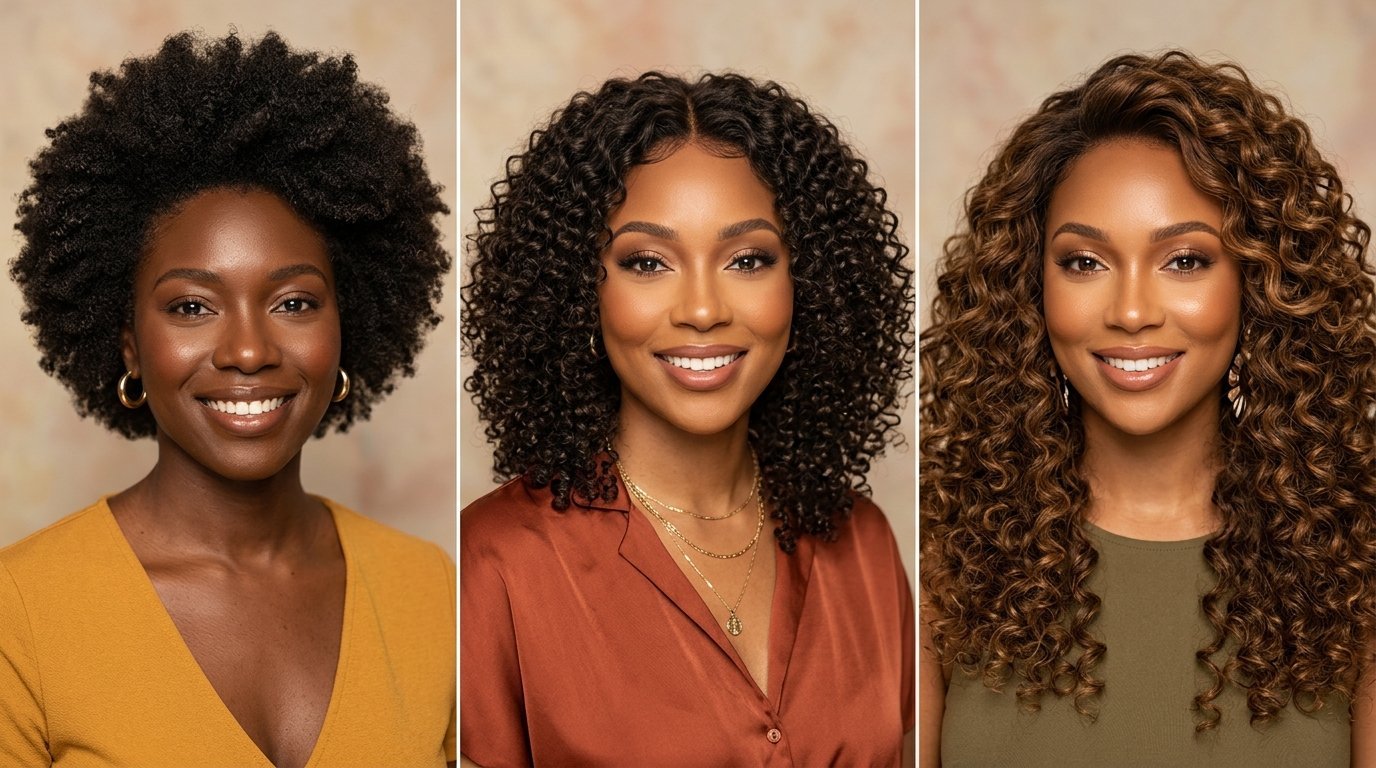
Choosing the right curly wigs for Black women is more specific than choosing a generic curly wig -- the textures, curl patterns, and density expectations that look natural and authentic on Black women are a particular subset of what the broader wig market offers, and not every "curly wig" in a retailer's catalog is designed with this aesthetic in mind. A black curly hair wig that genuinely looks natural on a Black woman requires attention to curl pattern, density distribution, fiber texture, and how the hairline is constructed.
This guide covers the full range of curly wigs for Black women -- from tight coily afro styles to defined ringlet lace fronts, from short cuts to long flowing curls -- and what distinguishes a wig that looks convincingly natural from one that looks like a costume piece regardless of price.
Understanding Curl Patterns in Wigs: What the Numbers Mean
The hair type classification system (3A through 4C) that natural hair communities use to describe curl patterns is directly applicable to wig selection. Matching your wig's curl pattern to your own natural texture produces the most seamless result when blending the wig with your natural hairline:
- Type 3A-3B (loose to medium curls): Large to medium spiral curls with clear definition. These are the most common curl patterns in mainstream curly wig offerings. Curly African American wigs in 3A-3B patterns are available in the widest range of lengths and constructions.
- Type 3C (tight curls): Tightly coiled curls with significant volume. 3C pattern wigs in curly hair lace front wigs Black women styles are among the most popular for their combination of defined curl and natural-looking density. The curl is tight enough to read as naturally textured without being as tightly coiled as 4-type hair.
- Type 4A-4B (kinky-coily): The coiled, zig-zag texture typical of many Black women's natural hair. Black curly afro wigs and kinky texture wigs typically fall in this range. These patterns have significant volume relative to their length and require specific care techniques to maintain definition.
- Type 4C (tight kinky coils): The tightest natural hair texture -- dense, tightly packed coils with maximum shrinkage. Real afro wigs in 4C-inspired textures are the most natural-looking option for women with 4C natural hair who want a wig that matches their own texture closely. These wigs require the most maintenance and benefit most from moisturizing products designed specifically for high-porosity, tightly coiled hair.
Short Curly Wigs for Black Women: The Most Practical Category
Short curly wigs for Black women are consistently the highest-performing category for ease of wear, maintenance, and natural appearance. Several reasons make short styles particularly practical:
- Shrinkage is less of a factor at short lengths -- a short black curly wig that is 4-6 inches long will look close to its advertised length because there is less differential between stretched and natural length. Long curly wigs, particularly in tighter patterns, may appear significantly shorter than their listed length when the curls contract.
- Shorter curl patterns require less daily maintenance -- no lengthy detangling sessions, less product to distribute through the hair, and faster drying time after washing.
- Short black curly wigs are typically lighter in weight, which makes them more comfortable for extended wear and reduces the tendency to slip that longer, heavier wigs sometimes develop.
- The TWA (teeny weeny afro) and short natural look is one of the most authentically natural-looking styles in the Black women's wig market -- a well-made short curly wig for Black hair in the right density and curl pattern can be genuinely indistinguishable from a natural short cut.
Short Curly Wigs for Black Hair: What to Look For
When evaluating short curly wigs for Black hair, the most important quality indicator is density distribution. Natural short curly hair has higher density at the roots and tapers slightly toward the perimeter. Wigs with uniform density throughout often look less natural than those with gradient density -- thicker at the crown, slightly lighter at the edges. Check buyer review photos specifically for density appearance, since product photos are often taken from angles that maximize volume appearance and may not represent how the wig looks from the front at eye level.
African Wigs and Afro Styles: Natural Texture Representation
African wigs encompass a range of styles that draw on the breadth of African and African-diasporic hair aesthetics -- from the natural afro to Bantu knot-out inspired textures to blown-out puff styles. Black curly afro wigs are the most direct representation of natural Black hair texture in wig form, designed to replicate the volume, texture, and shape of a natural afro rather than a styled or manipulated curl pattern.
A quality real afro wig has several distinguishing characteristics from lower-quality afro-shaped wigs:
- Natural density gradient: A real afro does not have uniform density in a perfect sphere -- it is denser at the crown and slightly less dense at the perimeter. Mass-market afro wigs often have very uniform round shapes that look more like a ball of hair than a natural afro.
- Authentic texture at the ends: Natural 4-type hair ends have a specific textured, slightly undefined look. Low-quality afro wigs often have ends that look too uniform or slightly plasticky. Higher-quality options have ends that look genuinely textured and natural even at close range.
- Appropriate shrinkage factor: Natural afro hair has significant apparent volume but also significant density and weight. A good real afro wig has the volume of a natural afro without being so lightweight and fluffy that it obviously lacks the density of real 4-type hair.
Curly Hair Lace Front Wigs for Black Women: The Construction Advantage
Curly hair lace front wigs Black women styles combine natural curl texture with the undetectable hairline that lace front construction provides. For curly wigs specifically, the lace front addresses one of the most difficult challenges in curly wig wearing: the hairline.
Natural curly hair at the hairline does not begin in a straight, uniform line -- it begins with baby hairs, with coils of varying sizes, with some strands growing in slightly different directions from others. A lace front construction allows each hair at the hairline to be placed individually, replicating this natural variation rather than presenting a uniform edge. For curly synthetic wigs for Black women, a lace front significantly elevates the natural appearance at the most visible and scrutinized part of the wig -- the front hairline.
HD Lace in Curly Wigs
High-definition (HD) lace is particularly valuable in black curly wigs with lace front construction. HD lace is thinner and more transparent than standard lace, allowing it to blend with a wider range of skin tones without the need for color customization. In curly wigs where the style draws attention to the top of the head and hairline, HD lace's superior blending reduces the visible lace grid that can be seen in standard lace under certain lighting conditions.
Medium Curly Wigs for African American Women: The Versatile Length
Medium curly wigs for African American women -- typically 12-18 inches in length -- occupy the sweet spot between the practicality of short styles and the drama of long curly wigs. At medium lengths, the curl pattern has enough room to develop its full shape and bounce without the weight and maintenance demands of very long curly wigs. Medium length also provides more styling options -- the same wig can be worn with curls loose, pulled back partially at the temples, pinned up at the crown, or with the front pinned back to reveal the hairline and lace construction.
For medium curly wigs for African American buyers specifically evaluating between human hair and synthetic construction: human hair in medium curly styles can be refreshed and restyled (stretched, defined, diffused) in ways that synthetic cannot, but a quality synthetic medium curly wig maintains its curl pattern more consistently between washes without requiring product application to define the curls.
Maintaining Curly Wigs: Keeping the Curl Definition
Curl definition in wigs -- particularly synthetic curly wigs for Black women -- requires specific maintenance practices:
- Use a microfiber towel, never a regular terry cloth towel: Terry cloth creates friction that disrupts curl pattern and causes frizz. A microfiber towel or an old cotton t-shirt blots water from curly wigs without disturbing the curl structure.
- Detangle with conditioner, fingers-first: Work a detangling conditioner or leave-in through damp curly wig hair section by section, using fingers to separate curl clumps before using a wide-tooth comb or Denman brush from ends upward.
- Apply curl cream or gel to refresh definition: Between washes, a light curl cream or gel applied to the wig's curl sections and scrunched gently from ends upward refreshes definition and reduces frizz at the wave peaks without requiring a full wash.
- Store properly to avoid compression: A curly wig stored compressed in a bag or box will have its curl pattern flattened. Store on a wig head or loosely placed in a large bag with minimal compression.
Frequently Asked Questions
How do I keep a curly lace front wig looking fresh and defined all day without it frizzing?
Frizz in curly hair lace front wigs Black women styles is primarily caused by three things: humidity drawing moisture into the fiber and disrupting the set curl pattern, friction from handling or clothing that disrupts the curl surface, and insufficient product to hold the curl definition against environmental conditions. The approach that produces the best all-day results: start with a light curl cream or defining gel applied section by section before wearing, scrunching gently from ends upward to encourage each curl to clump together cleanly rather than frizzing individually. A light anti-humidity product (available in natural hair sections at beauty supply stores) applied over the top as a final step creates a barrier against atmospheric moisture that is the primary driver of frizz in both synthetic and human hair curly wigs. During the day, avoid running hands through the wig -- finger-combing is the most common cause of mid-day frizz as it separates and disrupts the clumped curl definition. If the wig begins to frizz, a light water mist applied with a spray bottle and gentle scrunching can re-activate curl definition without requiring re-application of all products. For synthetic curly synthetic wigs for Black women, a diluted fabric softener spray (a few drops in water) also acts as a mild anti-static treatment that reduces the static-driven frizz that synthetic fiber can experience in dry conditions.
What is the difference between a regular curly wig and a real afro wig, and which is more natural-looking?
A regular curly wig typically has a defined, uniform curl pattern (3A-3C type spirals) throughout the piece -- the curls are consistent in size and shape, reflecting a styled or product-defined curl look. A real afro wig attempts to replicate the unstyled, natural-growth texture of 4-type hair -- the tight, coiled, high-shrinkage texture that is the baseline look of natural African hair without manipulation or styling products. The two are different aesthetics, not different quality levels. Which looks more natural depends entirely on the wearer's own natural hair texture: a woman with 3C natural hair will look most natural in a black curly hair wig with 3C pattern curls; a woman with 4C natural hair will look most natural in a real afro wig with 4C-inspired texture. The critical mistake many buyers make is choosing a curly wig based on attractiveness of the curl pattern in photos rather than compatibility with their own natural texture and hairline. A 3A loose spiral curl wig on a woman with tight 4C natural hair creates an obvious mismatch at the hairline -- the wig texture and the natural hair texture visible at the perimeter are incompatible, and no amount of edge control or baby hair styling completely resolves this mismatch. Matching curl pattern to your own texture is the single most important decision in selecting a natural-looking curly wig for Black women.
If you are a wig retailer, beauty supply business, or wholesale buyer looking to source curly wigs for Black women -- including curly lace front wigs, afro wigs, short curly styles, and medium length curly options -- at wholesale pricing, contact our sourcing team. We supply natural texture wigs across curl patterns and cap constructions at competitive wholesale pricing.
WhatsApp: +86 17347350405
Email: hello@voretrade.com