Can You Wash a Synthetic Wig with Regular Shampoo? The Honest Answer and What to Use Instead
August 13, 2026 · Marcus Vore
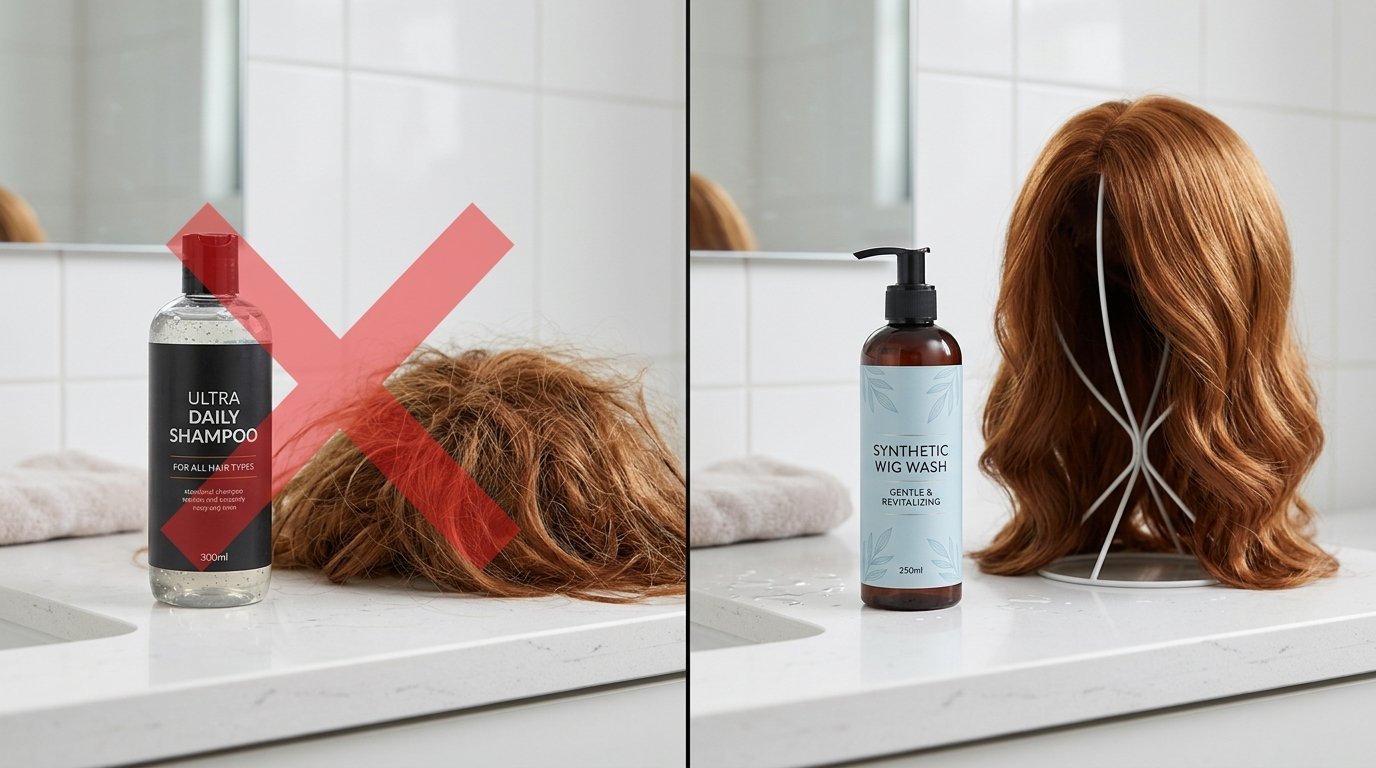
Most people ask the question can you wash a synthetic wig with regular shampoo right after they realize they have no specialized wig products and the wig needs cleaning now. The reassuring news is that using regular shampoo once is unlikely to cause catastrophic damage. The more important news is that making it a habit will shorten your wig's life noticeably -- and understanding why helps you make a better decision going forward.
This guide covers what happens when you use regular shampoo on a synthetic wig, what the better alternatives are, how often you should wash your wig, and the complete washing process that cleans effectively without accelerating wear.
Why Regular Shampoo Is Not Ideal for Synthetic Wigs
To understand why regular shampoo is problematic for synthetic fiber, it helps to understand what regular shampoo is designed to do. Shampoo formulated for natural hair has two primary functions: removing sebum (the oil produced by the scalp's sebaceous glands) and removing environmental buildup from the hair shaft. The active cleaning agents that accomplish this -- typically sulfates like sodium lauryl sulfate or sodium laureth sulfate -- are surfactants that strip oils from surfaces through a combination of emulsification and mechanical action.
Natural hair benefits from this because the scalp continuously produces new sebum to replace what washing removes. A synthetic wig has no scalp, no sebaceous glands, and no capacity to produce or restore surface oils. This creates two problems with regular shampoo use:
- Surfactant stripping of protective treatments: Quality synthetic wigs have factory-applied surface treatments -- silicone coatings, anti-static treatments, fiber softeners -- that give the wig its initial softness, sheen, and manageability. Sulfate-heavy regular shampoos strip these surface treatments efficiently. After several washes with regular shampoo, a synthetic wig often feels noticeably rougher, looks slightly duller, and tangles more easily than it did originally -- because the surface treatment that was doing that work is gone and cannot be replenished by natural biological processes.
- pH mismatch: Human hair shampoos are typically formulated at a slightly acidic pH (around 4.5-5.5) designed to work with the keratin protein structure of human hair. Synthetic fiber, being a polymer rather than a protein, has no particular benefit from this pH -- but some formulations designed for specific hair concerns (clarifying shampoos, anti-dandruff shampoos) have pH levels or active ingredients that can affect synthetic fiber surface properties in ways not apparent from a single wash but cumulative over time.
- Conditioning agents designed for the wrong substrate: Many modern shampoos include conditioning agents designed to bond to keratin (the protein in human hair). These agents do not bond to synthetic polymer fiber in the same way, meaning the conditioner component of 2-in-1 shampoos or conditioning shampoos provides no benefit to the wig fiber while adding product that must be rinsed out.
Can You Use Regular Shampoo on Synthetic Wigs in a Pinch?
Yes -- once or twice with a gentle, low-sulfate regular shampoo is unlikely to cause visible damage, particularly if the wig is rinsed thoroughly and followed with a diluted fabric softener rinse for conditioning. If you are traveling, between wig care product orders, or simply caught without the right product, using a small amount of a gentle baby shampoo or sulfate-free shampoo (rather than a clarifying or volumizing formula, which tend to be more aggressive) is a reasonable emergency option.
What to avoid even as a one-time substitution: clarifying shampoos (specifically designed to strip buildup, they are too aggressive for synthetic fiber), anti-dandruff shampoos (active ingredients like zinc pyrithione or salicylic acid are targeting scalp skin concerns irrelevant to wig fiber), and high-sulfate "deep cleansing" formulas. These will clean the wig but at a disproportionate cost to the fiber surface treatment.
What to Actually Use Instead
The alternatives to regular shampoo for washing a wig, in order of most purpose-appropriate:
Purpose-Formulated Synthetic Wig Shampoo
Shampoos specifically formulated for synthetic fiber are the correct choice. They are pH-balanced for synthetic fiber, use mild surfactants that remove sweat and environmental buildup without stripping surface treatments aggressively, and often include ingredients that maintain or restore some of the fiber's surface softness. Brands with well-regarded synthetic wig shampoos include: Brandywine Wig Shampoo (a staple in the wig care community for decades), CHI Synthetic Wig Care Shampoo, and the wig care lines from major brands like Revlon and Jon Renau. These are not expensive products -- a bottle typically lasts many months of regular wig washing.
Diluted Baby Shampoo (Acceptable Alternative)
Baby shampoo is formulated to be exceptionally gentle -- "no more tears" formulations use very mild amphoteric surfactants rather than sulfates as their primary cleansing agent. Diluted 1:3 with water (one part shampoo to three parts water), baby shampoo is one of the most widely recommended emergency alternatives for synthetic wig washing and is gentle enough for regular use if wig-specific shampoo is unavailable.
Sulfate-Free Shampoo (Reasonable Regular Use)
A sulfate-free shampoo -- widely available in the natural hair care section of most pharmacies and beauty supply stores -- avoids the most aggressively stripping surfactants while still providing effective cleaning. This is a practical option for wig owners who prefer to use one shampoo product for both their natural hair and their wigs, as long as they select a genuinely sulfate-free formula rather than a "gentle" formula that still contains sulfates.
Diluted Fabric Softener (Conditioning Rinse, Not Shampoo)
Diluted fabric softener (approximately 1 tablespoon in 2 cups of cool water) does not clean a wig but is an excellent post-wash conditioning rinse for synthetic fiber. It restores surface softness, reduces static, and improves manageability. Apply after the cleaning step, allow to sit for 2-3 minutes, then rinse with cool water.
How Often Should You Wash Your Wig?
The question of how often should you wash your wig depends on how you wear it:
- Daily wear: Every 7-10 days. Sweat, skin oil from the scalp area, and product buildup accumulate faster with daily wear.
- Regular wear (3-5 days/week): Every 14 days. The extended intervals between wearing sessions allow some self-recovery time.
- Occasional wear (once or twice weekly): Every 3-4 weeks, or when visual or odor signals indicate washing is needed.
- Event-only wear: After every 3-5 wearing sessions, or monthly at minimum even with infrequent use.
The reliable signals that a wash is needed regardless of schedule: noticeable odor, visible flatness or heaviness near the cap area, increased tangling difficulty, or visible residue from dry shampoo or styling products. Do not delay past these signals -- product and sweat buildup left too long is harder to remove and can degrade the cap material.
The Correct Washing Process for a Synthetic Wig
- Detangle first: Use a wide-tooth comb or wig brush to gently detangle before wetting. Start from the ends and work upward. Never detangle a wet synthetic wig aggressively -- wet fiber is more susceptible to stretching and breakage.
- Cool water only: Fill a basin with cool water. Never use warm or hot water -- heat causes synthetic fiber to lose its style set and can cause some fiber types to become frizzy or deformed.
- Submerge and soak: Submerge the wig in the cool water and allow it to soak for 3-5 minutes. This loosens surface buildup before shampoo is applied.
- Apply shampoo sparingly: Add a small amount of wig shampoo (or diluted baby shampoo) to the water, or apply directly to the wig cap area where most buildup concentrates. Gently swish the wig through the water rather than scrubbing. Scrubbing causes friction between fiber strands that leads to tangling and surface damage.
- Rinse thoroughly: Empty the basin, refill with clean cool water, and swish the wig to rinse. Repeat until the rinse water is completely clear. Incomplete rinsing leaves shampoo residue that becomes its own form of buildup.
- Conditioning rinse: Optional but recommended -- apply diluted fabric softener or wig conditioner, allow 2-3 minutes, then rinse with cool water.
- Blot, do not wring: Gently press the wig between clean towels to remove excess water. Never twist, wring, or rub the wig -- all of these cause tangling and fiber stress.
- Air dry on a wig stand: Place the wig on a wig head or stand and allow to air dry at room temperature. Keep away from direct sunlight and direct heat sources during drying. Reshape the style gently while damp if needed, then leave to set as it dries.
Frequently Asked Questions
My synthetic wig feels rough and tangles more after washing -- what went wrong?
This is almost always the result of one or a combination of: using regular shampoo with sulfates (which stripped the wig's surface treatment), washing in warm or hot water (which opens the fiber surface and causes frizzing), scrubbing the wig during washing (which mechanically disrupts the fiber surface and causes tangling), or incomplete rinsing (leaving shampoo residue that makes the fiber feel rough). The fix for an already-damaged fiber surface: a diluted fabric softener treatment (soak in a 1:20 fabric softener to water solution for 5-10 minutes, then rinse thoroughly with cool water) can restore some softness to a roughened fiber surface. This does not fully reverse the damage but meaningfully improves the feel and manageability. Going forward: switch to wig-specific or sulfate-free shampoo, wash only in cool water, use the swishing rather than scrubbing technique, and always finish with a fabric softener conditioning rinse. The roughness and increased tangling should improve over the next 1-2 wash cycles.
Can I use conditioner on a synthetic wig the same way I use it on natural hair?
Standard hair conditioners work differently on synthetic fiber than on natural hair. Conditioners formulated for human hair use ingredients (like cationic surfactants and proteins) that bond to the negatively charged surface of damaged natural hair cuticle -- this bonding mechanism is what makes them effective. Synthetic fiber polymer does not have the same surface chemistry as natural hair, so these bonding mechanisms do not work the same way. A regular hair conditioner applied to a synthetic wig provides some surface coating benefit from the emollient ingredients but does not provide the cuticle-repair function it provides on human hair. More practically: heavy rinse-out conditioners can leave a residue on synthetic fiber that is difficult to fully rinse out, contributing to buildup. The most effective conditioning approach for synthetic wigs -- and the one recommended consistently in the wig care community -- is the fabric softener rinse (diluted significantly as described above) rather than standard hair conditioner. Purpose-formulated synthetic wig conditioners are the other appropriate option. If you want to use a standard hair product as a leave-in for synthetic wigs, a very light silicone serum (applied sparingly to the fiber surface after washing and drying) provides smoothness and anti-frizz benefits in a form that synthetic fiber responds to well.
If you are a wig retailer, beauty supply business, or salon operator looking to source synthetic wigs at wholesale pricing, contact our sourcing team. We supply synthetic wigs and hair products for retail businesses at competitive wholesale pricing.
WhatsApp: +86 17347350405
Email: hello@voretrade.com