Best Wig Styles for Seniors: What to Stock for the 50+ Market
May 18, 2026 · Marcus Vore
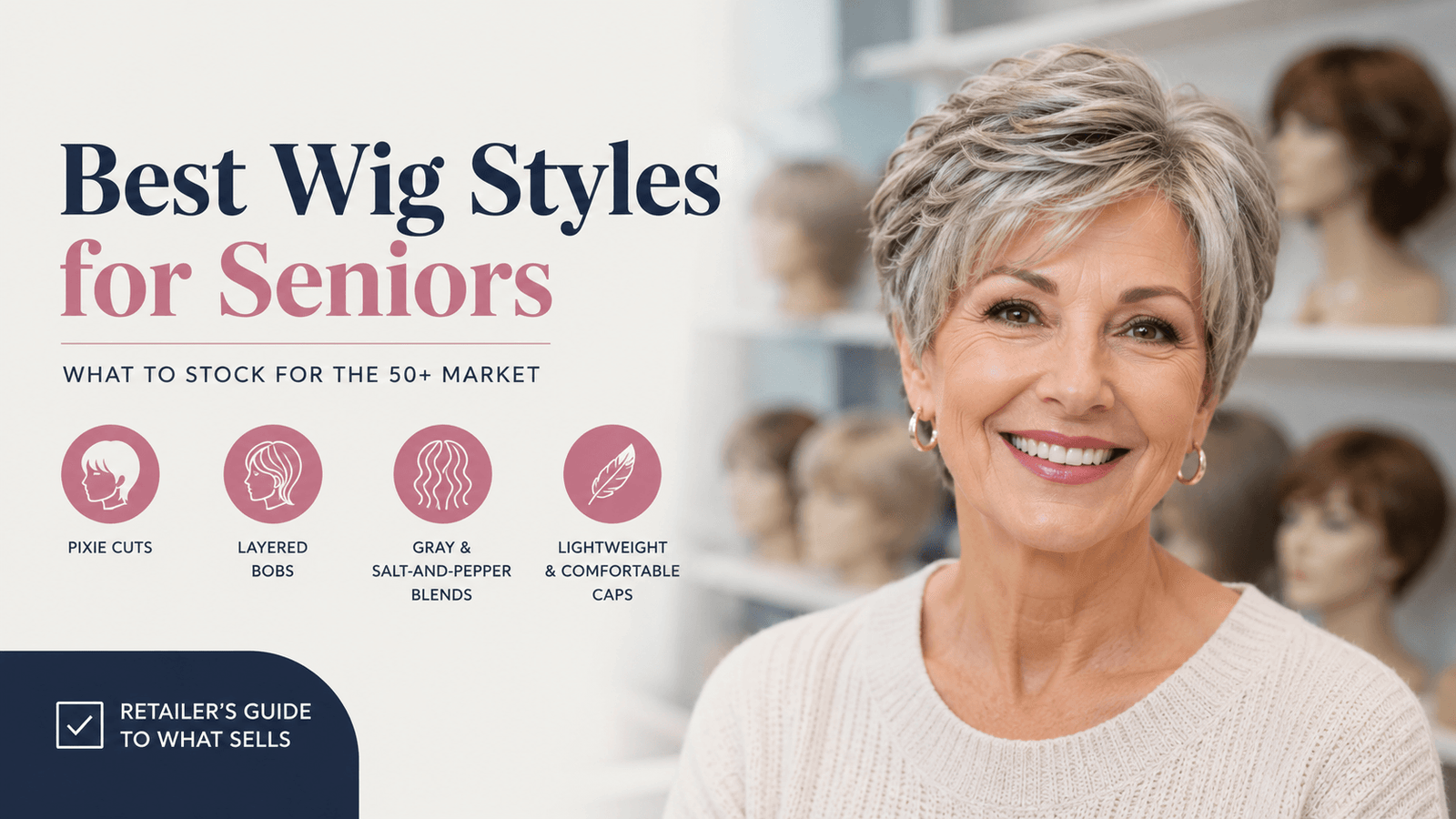
The best wig styles for seniors are short pixie cuts, layered bobs, and soft curly crops in salt-and-pepper, gray, or natural brown shades -- all with lightweight caps and 130-150% density. If you stock these three styles in these specs, you cover roughly 80% of what the 50+ customer actually buys. The remaining 20% is knowing which variations sell where.
Here is the problem most wig retailers run into: they stock for Instagram. Long lace fronts, 200% density, jet black, 22-inch body wave. And those sell -- to 25-year-olds. But your most reliable customer is a 62-year-old woman who wears a wig every single day. She wants something lightweight she can put on in 30 seconds, that does not feel like a helmet by 3 p.m., and that looks natural enough that her bridge partners do not ask questions.
She buys more. She returns less. She tells her friends. She is your profit center. Here is what she is actually looking for -- and how to source it.
Key Takeaways - Pixie cuts and chin-length layered bobs are the two highest-volume styles for the 50+ market; stock both before experimenting with longer or trendier options - Salt-and-pepper and gray blends are the fastest-growing color category -- carry at least four gray variants (15%, 25%, 40%, 60% blends) - Cap comfort determines return rates more than hair quality does -- monofilament tops and adjustable straps are non-negotiable for this demographic - 130-150% density is the sweet spot for seniors; anything over 180% feels heavy, hot, and unnatural on older customers - Source from suppliers who understand senior-specific needs: graduated hairlines (90-110% at the front), pre-plucked lace, and ear tabs that accommodate glasses
Why the Senior Wig Market Deserves Its Own Inventory Strategy
The numbers make the case before you read another word. Buyers aged 50 to 64 represent 48% of global wig purchases. Not a niche. Nearly half the market.
The global wig market hit an estimated $4.5 billion in 2024 and is projected to reach $8-10 billion by 2032, growing at 7-9% annually. The single biggest driver of that growth is not fashion trends or social media. It is demographics: the World Health Organization projects 1 in 6 people will be over 60 by 2030. By age 70, over 55% of women experience visible hair loss, according to Mayo Clinic research. The Grand View Research wig market report confirms the senior segment is the largest growth driver.
Those women need wigs. And most of them are not being served well by the inventory choices the average wig retailer makes.
Maria runs a small beauty supply shop in Houston. Last year, she ordered what she thought would sell -- a mix of 22-inch body wave lace fronts and 180% density deep wave styles. Her Instagram feed was full of them. Six months later, half that inventory was still on her shelves. The products that moved? A gray pixie cut she had ordered almost as an afterthought. A salt-and-pepper bob that she stocked because a customer specifically asked for it. Three women came back and each bought a second unit in a different gray blend.
Maria is not an outlier. She is the pattern.
The senior wig buyer has different priorities than the 25-year-old influencer-driven customer. She values comfort over drama. Natural over glamorous. Ease over elaborate styling. If your inventory does not reflect those priorities, you are sitting on stock that moves slowly while the fastest-growing demographic buys elsewhere.
Top Wig Styles That Sell to Senior Customers
Here is what actually moves units with the 50+ market, based on what we see across our buyer base shipping to North America, Europe, the Middle East, and Africa.
Pixie Cuts: The Bestseller for Comfort and Convenience
Pixie cuts are the #1 selling senior wig style for a reason that has nothing to do with fashion: they are the lightest, coolest, and easiest to wear.
A well-made pixie wig weighs 120-150 grams. Compare that to a 22-inch lace front at 250-300 grams. For a woman who wears her wig 8-12 hours a day, that weight difference is the gap between "I forget I am wearing it" and "I cannot wait to take this off."
They are also the best option for seniors with arthritis or limited hand mobility. No sectioning, no styling, no tools. Shake it out, put it on, done.
Sourcing specs for pixie wigs destined for the senior market: - Length: 6-8 inches - Density: 130% (natural daily wear) or 150% (slightly fuller) - Cap: glueless with adjustable straps and ear tabs - Hairline: pre-plucked with bleached knots - Color priority: salt-and-pepper blends #1, solid gray/silver #2, natural brown #3
Layered Bobs: The Universal Best-Seller
If you can only stock one style for seniors, make it a layered bob. Chin to shoulder length, soft face-framing layers, works on virtually every face shape and with every personal style.
The layered bob outsells the pixie in markets where customers still want some length to style -- particularly European and Middle Eastern buyers. It gives enough hair to run a brush through, add a gentle curl, or pin one side back, without the weight and maintenance of longer lengths.
A buyer in the UK told us her return rate dropped from 18% to under 5% when she switched her senior-focused inventory from 18-inch styles to 12-inch layered bobs. The reason her customers gave: "It does not pull at my scalp by the end of the day."
Sourcing specs for layered bobs: - Length: 10-14 inches - Density: 150% (standard) or 130% (for the "natural volume" segment) - Cap: monofilament top + lace front minimum; full hand-tied if budget allows - Layers: specify "face-framing graduation" in your order notes -- short layers at the cheekbone, longer at the chin - Color priority: gray blends and warm browns with subtle highlights
Short Curly and Wavy Styles: Volume Without Weight
For senior customers with very thin natural hair, curly and wavy short styles create the perception of fullness without the physical weight of high density.
A 150% density body wave or loose curl wig looks as full as a 180-200% straight wig because of how the texture occupies space. That means you get the visual volume your customer wants at a weight and cost that works for daily wear.
Important distinction: Soft waves and loose curls sell to seniors. Tight curls and defined ringlets do not -- those read as costume-like to most 50+ buyers, unless you are specifically serving the African American market where tighter curl patterns are culturally preferred and expected.
Sourcing specs for curly/wavy styles: - Length: 8-12 inches (curls read shorter; a 10-inch curly wig looks like a 6-8 inch straight wig) - Density: 150% (the texture creates the volume; no need to go higher) - Texture: body wave, loose wave, water wave -- not tight curl or deep wave for general market - Cap: monofilament top with open wefts for breathability
Classic Straight Bob: The Elegant Staple
The straight bob is the dress watch of senior wigs -- understated, classy, appropriate everywhere. It does not generate excitement the way a new texture or color trend does, but it sells steadily month after month, year after year.
This style appeals most to the 65+ customer who wants nothing trendy. She wants what she had when she was 45, and she wants it to look like it could be her own hair. Clean lines, natural color, no obvious "wig" tells.
Sourcing specs for straight bobs: - Length: 12-14 inches - Density: 130-150% (higher reads unnatural on straight hair) - Cap: monofilament top is essential -- there is no curl to hide the cap with this style - Quality priority: cuticle alignment matters more on straight styles. Any tangling or flyaway is immediately visible.
What Does Not Sell to Seniors (And Why)
Just as important as knowing what to stock is knowing what to skip. These styles generate the highest return rates from 50+ customers:
| Style | Problem | What Happens |
|---|---|---|
| 22"+ lengths | Too heavy, tangles constantly, pulls at scalp | Returned within 2 weeks |
| 200%+ density | Hot, unnatural-looking, feels like a helmet | Worn once, never again |
| Bold colors (platinum blonde, red, fantasy) | Does not match natural coloring | Sits in inventory indefinitely |
| Full lace with glue installation | Too complicated, too much maintenance | Intimidating to the customer |
| Ultra-defined curls or ringlets | Looks costume-like on older women | Returned as "not me" |
One exception to note: the African American senior market prefers higher density (180-200%) and specific curl patterns as the cultural norm. What reads as "too much" for one market is "too thin to wear" in another. Know your customer.
Color Strategy for Senior Wigs: Stocking for the Gray Market
The single biggest inventory mistake in the senior wig space is ordering the wrong colors. Here is the rule: if your stock is 80% dark brown and jet black, you are leaving the senior market on the table.
Salt-and-Pepper Blends: The #1 Color Opportunity
Salt-and-pepper wigs are the best-selling color category for the 50+ market, and most retailers understock them. The reason is straightforward: a woman who is 40% gray in her natural hair looks unnatural in a solid black wig. The contrast at the hairline reads as "wig" from across the room.
Salt-and-pepper blends solve this by matching what her hair actually looks like.
The four gray blends you need: - 15% gray -- for women just beginning to gray (late 40s to mid 50s) - 25% gray -- the most popular blend; looks natural on most women 55-70 - 40% gray -- for women who have embraced their gray but still want some depth - 60% gray -- for women who are predominantly gray/silver; growing demand as "going gray" becomes mainstream
Solid Gray and Silver
The fastest-growing color trend in senior wigs is not a trend at all -- it is women stopping the dye cycle and letting their gray show. Solid gray and silver wigs have seen demand increase sharply in the last two years, driven by the "go gray" movement and high-profile women embracing silver hair.
Two gray tones to stock: - Silver/steel gray -- cool undertone, best on fair to medium skin with pink or neutral undertones - Warm gray/mushroom -- beige-gray with warm undertones, best on olive or warm skin tones
A retailer in Toronto told us she could not keep silver pixie cuts in stock last year. She had ordered them as a "maybe" for her older customers. They sold out in three weeks, and a surprising number of buyers were women in their 40s.
Natural Browns and Soft Balayage
Not every senior customer is gray. Many women 50-70 still color their natural hair or have only partially grayed. For these customers, stock: - Natural black (#1B) -- softer than jet black (#1), much more natural on mature skin - Dark brown with subtle face-framing highlights - Rooted balayage browns -- the darker root creates a natural grow-out look that reads as "real hair"
Recommended Color Ratio for Senior-Focused Stock
70% classics: salt-and-pepper blends (all percentages), natural browns, natural black
20% trending: solid gray/silver, mushroom gray, rooted balayage
10% experimental: auburn, honey blonde, soft ombre -- order small, see what moves
If your customer base is predominantly African American, adjust: keep the 70/20/10 split but shift the classics to natural black, dark brown, and gray blends, with trending focused on rooted colors and subtle highlights.
Cap Construction: The Spec That Determines Returns
Here is something most wig buying guides skip: cap comfort causes more returns from senior customers than hair quality does.
An older scalp is different from a young one. The skin is thinner. It is more sensitive to pressure points and heat. Many seniors have partial hair loss rather than full baldness, which means clips and combs can pull painfully on remaining hair. And a large percentage wear glasses -- ear tabs that press glasses arms into the temple become unbearable within an hour.
The Minimum Viable Cap for a Senior Wig
If you stock nothing else, stock wigs with these three features:
-
Monofilament top -- A soft mesh material at the crown that mimics scalp. It allows multidirectional parting, breathes better than solid caps, and does not scratch. For a senior customer, this is the single most important cap feature.
-
Adjustable straps at the nape -- Velcro or hook-and-loop straps that let the wearer customize the fit. Seniors' head sizes vary more than younger buyers' because of bone structure changes with age. A wig that fits your 35-year-old mannequin may be too tight or too loose on your 68-year-old customer.
-
Open weft construction -- Wefts with space between them allow airflow to the scalp. Closed caps trap heat. After 4-6 hours of wear, that temperature difference determines whether the wig stays on or comes off.
Cap Features Worth Paying More For
| Feature | Cost Impact (Wholesale) | Value to Senior Customer |
|---|---|---|
| HD lace front | +$3-6 per unit | Very high -- invisible hairline = confidence |
| Hand-tied cap | +$8-15 per unit | High -- softest, most breathable option |
| Pre-plucked hairline | +$1-2 per unit | High -- "ready to wear" out of the box |
| Bleached knots | +$1-2 per unit | High -- lace disappears against scalp |
| Silicone grip strip | +$1-3 per unit | Medium -- security without clips |
| Cotton/bamboo lining | +$1-2 per unit | Medium -- comfort for sensitive scalps |
| Glasses-compatible ear tabs | +$0-1 per unit | Critical for glasses wearers -- specify this |
Cap Features to Avoid for Senior Stock
- Internal metal combs -- pull on thinning hair, cause pain, get returned
- Basic machine-made caps -- hot, scratchy, look fake at the part
- Glue-only attachment -- intimidating and impractical for most seniors
- One-size-fits-all without adjustment -- simply does not work for this demographic
Density by Age Group
Density preferences shift with age. Here is what moves at each bracket:
| Age Group | Recommended Density | Why |
|---|---|---|
| 50-60 | 150-180% | Still want fullness and styling versatility |
| 60-70 | 130-150% | Prioritize comfort; want natural volume without weight |
| 70+ | 120-130% | Maximum comfort; lighter = better for all-day wear |
| Hairline (all ages) | 90-110% | Always lighter at the front for natural graduation |
Specify density graduation in your order: "130% overall density, 100% at the hairline graduating to 150% at the crown." A supplier who understands this instruction is a supplier worth keeping. Our 4-step verification process catches density mismatches before they ship -- factory audit, sample approval, production QC, and pre-shipment inspection with photos sent to you before final payment.
How to Source Senior Wigs from Chinese Factories
Knowing what to stock is step one. Getting what you ordered is step two. Senior wigs have specific requirements that generic orders do not cover. We covered how to find reliable suppliers in a separate guide -- here we focus on getting the senior-specific details right once you have found a factory.
What to Specify in Your Order
Do not assume your supplier knows what "for seniors" means. Spell it out:
Cap: monofilament top, lace front, open weft, adjustable straps
Density: [X]% overall, graduated from 100% at hairline to [X]% at crown
Color: [specific gray blend %] or [specific color code]
Lace tint: transparent or light brown (not medium brown -- too dark for mature fair skin)
Knots: bleached, single-knot at hairline
Ear tabs: reinforced, glasses-compatible
Hairline: pre-plucked, natural irregular density (not ruler-straight)
Construction: glueless -- silicone grip strip preferred, no internal combs
Red Flags When Sourcing Senior Wigs
-
Gray blends that look blue or purple -- A common processing error when factories use the wrong toner on gray hair. Request photos in natural daylight, not studio lighting where color casts are hidden.
-
Hairlines that are too dense and too straight -- The #1 "this looks like a wig" tell. A natural hairline has irregular density and baby hairs. A factory hairline that looks like a ruler was used to place each strand reads as fake from any distance.
-
Caps that do not stretch -- Seniors need a comfortable, adjustable fit. If the cap has no give, it will be returned.
-
Gray fibers that are coarse or wiry -- Gray human hair is naturally finer than pigmented hair. If gray sections feel coarse, the hair has been over-processed or mixed with lower-grade fibers.
Sample Order Checklist
Before committing to bulk, order 2-3 sample units and check:
- Weight: a 12-inch 150% density wig should weigh roughly 140-160g. Significantly lighter = lower density than claimed.
- Cap comfort: wear it or have someone wear it for 4+ hours. Any pressure points?
- Gray accuracy: photograph in natural light. Does it look gray or does it cast blue/purple?
- Shed test: 10 brush strokes. More than 8 loose hairs = reject.
- Ear comfort with glasses: have a glasses-wearer test the fit at the temples.
- Shipping method: samples are small enough for express courier (3-7 days). For bulk orders, review our complete shipping guide to choose between sea freight, air freight, and DDP options.
Frequently Asked Questions
For more general sourcing and ordering questions, visit our FAQ page. Here are the questions we hear most often about stocking wigs for senior customers:
What is the best wig style for a 70-year-old woman?
A short pixie cut or chin-length layered bob in 130% density with a monofilament top and adjustable straps. These styles are the lightest, most comfortable for all-day wear, and most flattering on mature face shapes. Salt-and-pepper or gray blends look more natural than solid dark colors at this age.
Are human hair wigs better than synthetic wigs for seniors?
It depends on the customer's priority. Human hair looks more natural, lasts 6-12+ months, and can be heat-styled -- but it costs more and requires regular washing and conditioning. High-quality synthetic wigs are lighter, pre-styled (no daily styling needed), and cost less -- ideal for seniors with limited mobility or who want minimum maintenance. Many retailers stock both: human hair for the premium segment, synthetic for the convenience segment.
What wig density is best for older women?
130-150% density works best for most senior customers. 130% is ideal for everyday natural wear. 150% provides slightly more fullness without the weight and heat of higher densities. Avoid 180%+ for the general senior market -- it feels heavy, looks unnatural on mature faces, and generates more returns.
How do I choose a wig for an elderly parent with thinning hair?
Choose a glueless style with a monofilament top and adjustable straps -- no clips or combs that pull on thinning areas. A short pixie or bob in her natural color (or a salt-and-pepper blend if she has gray) will be lightest and most comfortable. If possible, involve her in the selection rather than surprising her with a wig. Bring photos of styles in her color range and let her choose.
What cap type is most comfortable for sensitive scalps?
A hand-tied or monofilament top cap with open wefts and adjustable straps. The monofilament material is soft against the scalp, the open wefts allow airflow, and the adjustable straps prevent pressure points. Avoid basic machine-made caps and internal combs entirely for sensitive scalps.
What colors look most natural on senior women?
Salt-and-pepper blends (15-40% gray), soft gray, silver, and warm natural browns look most natural. The key is matching the wig color to the natural gray pattern at the temples and hairline -- that is where color mismatch is most visible. Solid jet black is the least natural-looking color on most senior women.
How long do wigs last with daily senior wear?
A quality human hair wig with monofilament cap lasts 6-12 months of daily wear with proper care. A high-grade synthetic wig typically lasts 2-4 months of daily wear. For senior customers, include a care card with each purchase: how to wash, how to store overnight, and when to replace. Customers who know how to maintain their wig buy replacements on a predictable schedule.
Make the Senior Market Your Strongest Category
The math is simple: nearly half of all wig buyers are over 50, but most wig retailers stock for 25-year-olds. That gap between what is available and what is wanted is your opportunity.
Stock short. Stock comfortable. Stock gray. Source from suppliers who understand that a 65-year-old daily wearer needs a different product than a 22-year-old occasional wearer. Specify density graduation, monofilament tops, and glasses-compatible ear tabs on every order.
Get the product right for this customer, and you do not just make a sale. You earn a repeat buyer who reorders every 4-6 months, refers her friends, and rarely returns anything.
Need help sourcing senior-friendly wig inventory for your market? Tell us your target customer demographic and we will put together a sample pack of the styles, colors, and densities that move best in your region.
- WhatsApp: +86 17347350405 (fastest response)
- Email: hello@voretrade.com
No commitment -- just a conversation about what your customers are looking for.